Description
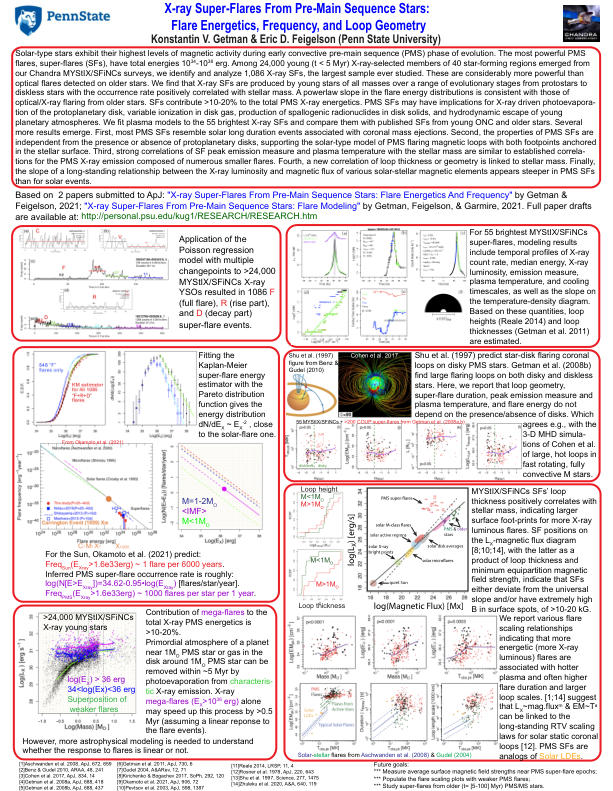
Solar-type stars exhibit their highest levels of magnetic activity during early convective pre-main sequence (PMS) phase of evolution. The most powerful PMS flares, super-flares (SFs), have total energies 1034-1038 erg. Among 24,000 X-ray members of 40 young star-forming regions emerged from our Chandra MYStIX/SFiNCs surveys, we identify and analyze a sample of 1,086 X-ray SFs, the largest sample ever studied. These are considerably more powerful than optical flares detected on older stars. We find that X-ray SFs are produced by young stars of all masses over a range of evolutionary stages from protostars to diskless stars with the occurrence rate positively correlated with stellar mass. A powerlaw slope in the flare energy distributions is consistent with those of optical/X-ray flaring from older stars. SFs contribute >10-20% to the total PMS X-ray energetics. PMS SFs may have implications for X-ray driven photoevaporation of the protoplanetary disk, variable ionization in disk gas, production of spallogenic radionuclides in disk solids, and hydrodynamic escape of young planetary atmospheres. We fit plasma models to the 55 brightest X-ray SFs and compare them with published SFs from young ONC and older stars. The distributions of SF properties are indistinguishable for disk-bearing and diskless stars, evidence that star-disk magnetic fields are not involved. Inferred positive correlations of the flare X-ray emission and plasma temperature with stellar mass suggest that PMS characteristic emission is composed of micro-flares. Such correlations indicate that RTV loop scaling laws are universal. However our models suggest that flares from more massive stars are associated with thicker coronal loops. In the Sun, the rare X-ray streamers may be the closest analogues to the PMS SFs.
Conference Information
The 20.5th Cambridge Workshop on Cool Stars, Stellar Systems, and the Sun
Identifiers
Authors
Konstantin V. Getman
ORCID: https://orcid.org/0000-0002-6137-8280
Eric D. Feigelson
Penn State University