Description
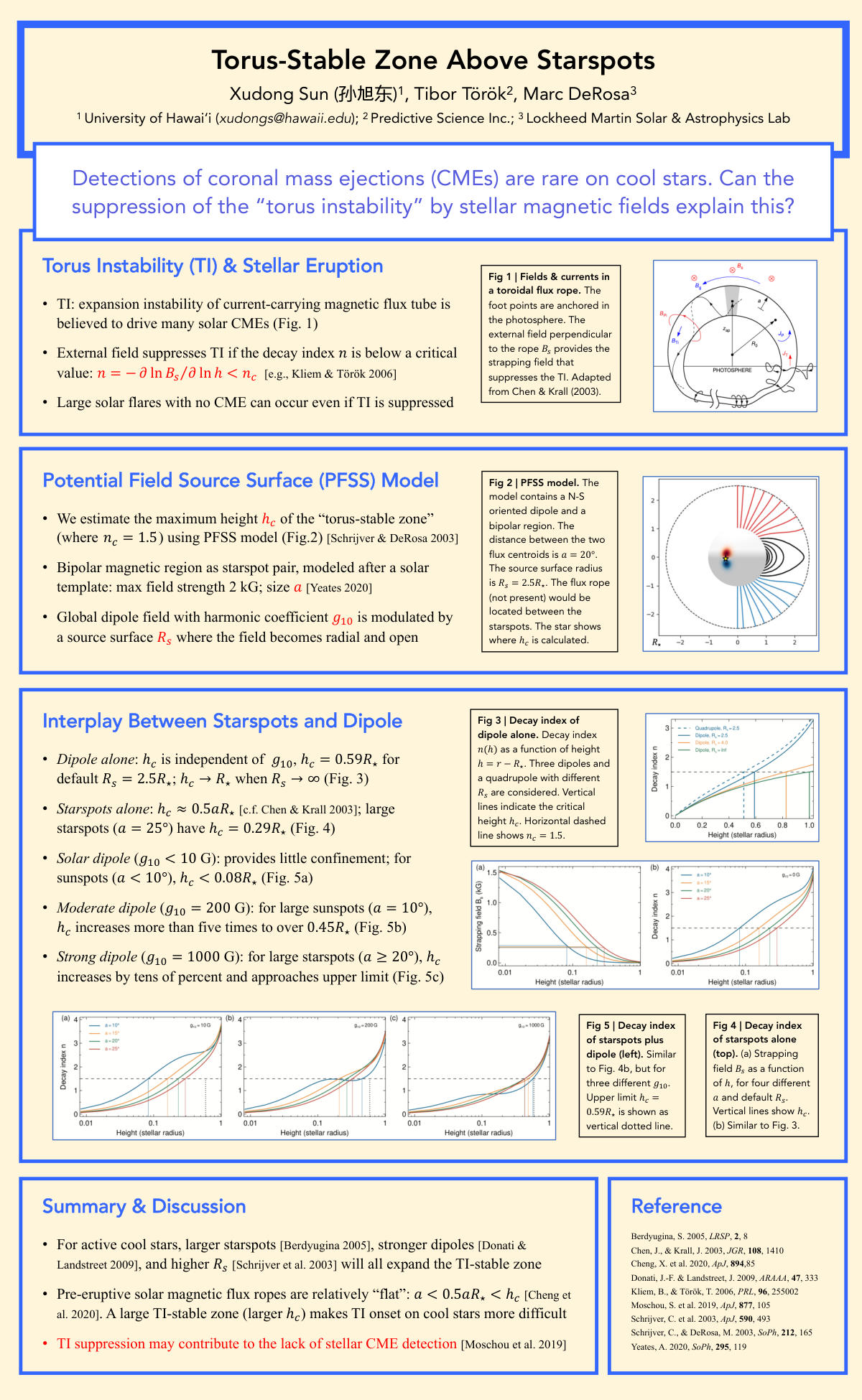
The torus instability (TI) of current-carrying magnetic flux tubes is thought to drive many solar coronal mass ejections (CMEs). The background magnetic field provides the stabilizing force: if it decreases with height at a rate slower than a critical value, the TI may be suppressed. Here we estimate the vertical extent of a "torus-stable zone" above starspots using a scaled model for the Sun. For a potential-field model comprising a bipole (as a pair of starspots) in alignment with a global dipole, we show that the upper bound of this zone hc increases with the bipole size a, the dipole field with harmonic coefficient g10, and the source surface radius Rs where the magnetic field becomes radial. The value of hc, ranging from about 0.5a to a significant fraction of the stellar radius, depends on the interplay between the spot and dipole magnetic fields; its upper limit is set by Rs. Suppression of the TI may contribute to the lack of CME detection from active cool stars, as larger starspots, stronger dipole, and more closed magnetic topology significantly expand the torus-stable zone.
Conference Information
The 20.5th Cambridge Workshops of Cool Stars, Stellar Systems, and the Sun
Identifiers
Authors
Xudong Sun
University of Hawaii
ORCID: https://orcid.org/0000-0003-4043-616X
Tibor Török
Predictive Science Inc.
ORCID: https://orcid.org/0000-0003-3843-3242
Marc DeRosa
Lockheed Martin Solar and Astrophysics Laboratory
ORCID: https://orcid.org/0000-0002-6338-0691