Description
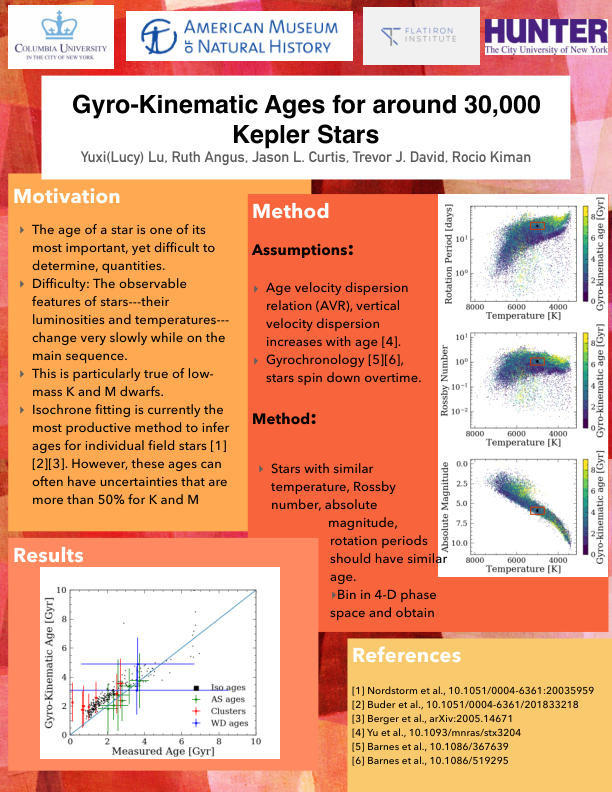
Estimating stellar ages is important for advancing our understanding of stellar and exoplanet evolution and investigating the history of the Milky Way. However, ages for low-mass stars are hard to infer as they evolve slowly on the main sequence. In addition, empirical dating methods are difficult to calibrate for low-mass stars as they are faint. In this work, we calculate ages for Kepler F, G, and crucially K and M dwarfs, using their rotation and kinematic properties. We apply the simple assumption that the velocity dispersion of stars increases over time and adopt an age--velocity--dispersion relation (AVR) to estimate average stellar ages for groupings of coeval stars. We calculate the vertical velocity dispersion of stars in bins of absolute magnitude, temperature, rotation period, and Rossby number and then convert velocity dispersion to kinematic age via an AVR. Using this method, we estimate gyro-kinematic ages for 29,949 Kepler stars with measured rotation periods. We are able to estimate ages for clusters and asteroseismic stars with an RMS of 1.22 Gyr and 0.26 Gyr respectively.
Identifiers
Authors
Yuxi (Lucy) Lu
Columbia University, American Museum of Natural History
ORCID: https://orcid.org/0000-0003-4769-3273
Ruth Angus
American Museum of Natural History, Flatiron Institute, Columbia University
ORCID: https://orcid.org/0000-0003-4540-5661
Jason L. Curtis
American Museum of Natural History
ORCID: https://orcid.org/0000-0002-2792-134X
Trevor J. David
Flatiron Institute, American Museum of Natural History
ORCID: https://orcid.org/0000-0001-6534-6246
Rocio Kiman
City University of New York, American Museum of Natural History
ORCID: https://orcid.org/0000-0003-2102-3159