Description
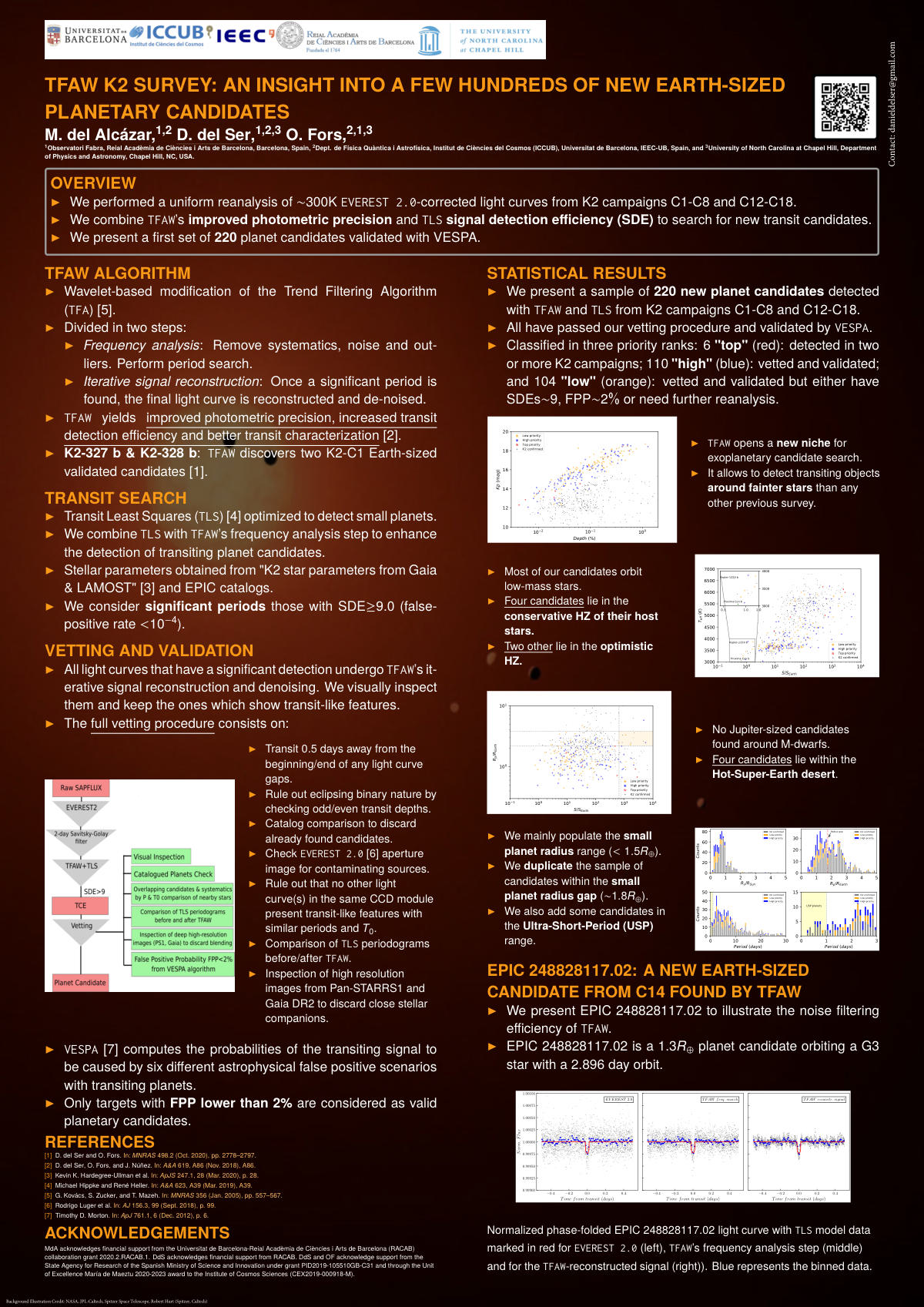
Kepler's extended mission (K2) Earth-sized planetary legacy is a niche that still remains to be fully exploited. We reanalyzed all light curves in K2 C1-C8, C12-C18 campaigns with a wavelet-based detrending method \texttt{TFAW} developed by our team, and the period search algorithm \texttt{TLS}. The combination of these two methods allows to detect and characterize planetary transit candidates around fainter targets ($12.5 < K_{\rm p} < 18.5$) than any previous study. We present 220 new planetary candidates as a result of a preliminary survey. All of them have passed a vetting procedure including: candidate periods with SDE$_{\rm TLS}>$9.0, visual inspection of the candidate light curve, inspection of archival Pan-STARRS1 images and Gaia DR2 to discard close stellar companions and statistical FPP$<$2$\%$. We assigned our candidates sample three levels of priority: six top-priority detected in two or more separate but overlapping K2 campaigns, 110 high-priority meeting the above requirements, and 104 low-priority still meeting the same requirements, but having either FPP close to 2$\%$ or pending further reanalysis. The bulk of our \texttt{TFAW} K2 survey are small planet candidates with $R_{p}<2 R_{\oplus}$, most of them orbiting faint low-mass stars. Our survey adds new candidates to different areas of interest in exoplanetary science: several dozens in the small planet radius gap, four in the Hot-Super-Earths desert, and a few in the Ultra-Short-Period planets. We also present six candidates within the Habitable Zones of their host stars.
Conference Information
The 20.5th Cambridge Workshop on Cool Stars, Stellar Systems, and the Sun
Identifiers
Authors
M. del Alcázar
$^{1}$Dept. de F{\'i}sica Qu{\`a}ntica i Astrof{\'i}sica, Institut de Ci{\`e}ncies del Cosmos (ICCUB), Universitat de Barcelona, IEEC-UB, Spain \\$^{2}$Observatori Fabra, Reial Acad{\`e}mia de Ci{\`e}ncies i Arts de Barcelona, Barcelona, Spain
D. del Ser
$^{1}$Dept. de F{\'i}sica Qu{\`a}ntica i Astrof{\'i}sica, Institut de Ci{\`e}ncies del Cosmos (ICCUB), Universitat de Barcelona, IEEC-UB, Spain \\$^{2}$Observatori Fabra, Reial Acad{\`e}mia de Ci{\`e}ncies i Arts de Barcelona, Barcelona, Spain \\ $^{3}$University of North Carolina at Chapel Hill, Department of Physics and Astronomy, Chapel Hill, NC, USA \\
ORCID: https://orcid.org/0000-0001-6776-3211
O. Fors
$^{1}$Dept. de F{\'i}sica Qu{\`a}ntica i Astrof{\'i}sica, Institut de Ci{\`e}ncies del Cosmos (ICCUB), Universitat de Barcelona, IEEC-UB, Spain \\$^{2}$Observatori Fabra, Reial Acad{\`e}mia de Ci{\`e}ncies i Arts de Barcelona, Barcelona, Spain \\ $^{3}$University of North Carolina at Chapel Hill, Department of Physics and Astronomy, Chapel Hill, NC, USA \\
ORCID: https://orcid.org/0000-0002-4227-9308