Description
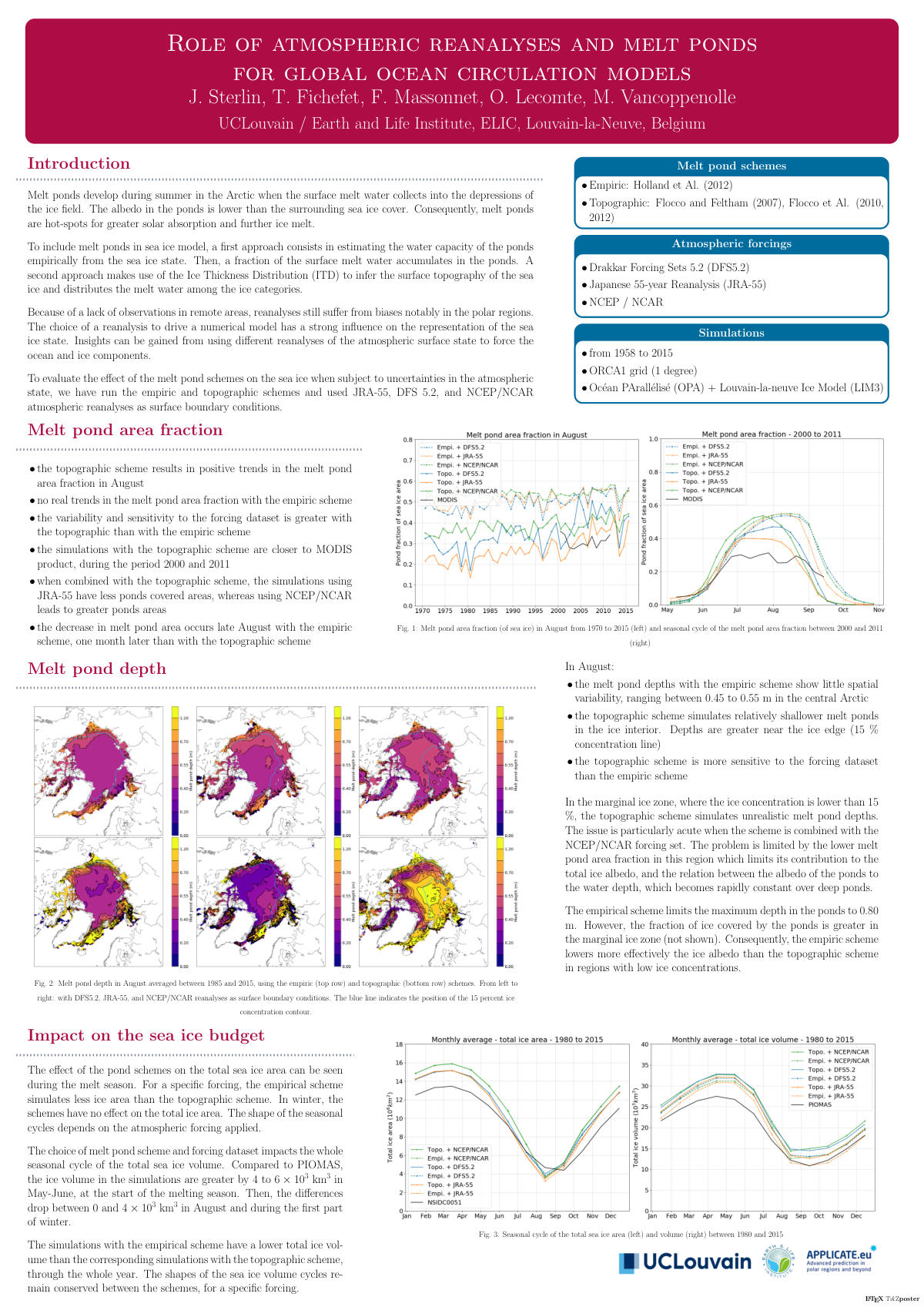
Melt ponds develop during summer in the Arctic when surface freshwater collect into the depressions of the ice field. Because of the liquid state of the water, the albedo in the ponds is lower than the surrounding sea ice cover. Consequently, melt ponds are hot-spots for greater solar absorption and further ice melt. It is customary in GCM to take into account melt pond effects indirectly by tuning the albedo of the ice to lower values. However, this method does not reflect the complexity the ponds and their contribution to the mean ice albedo. To include melt ponds in sea ice model, a first approach consists in estimating the water capacity of the ponds empirically from the sea ice state. Then, a fraction of the surface melt water accumulates is the ponds. A second approach makes use of the Ice Thickness Distribution to infer the surface topography of the sea ice and distribute the melt water among the ice categories. Although the role of melt ponds has been extensively studied, less is known on the response of the ponds to atmospheric uncertainties. Insights can be gained from using different reanalyses of the atmospheric surface state to force the ocean and ice components. Because of a lack of observations in remote areas, reanalyses still suffer from biases notably in the polar regions. The choice of a reanalysis has a strong influence on the representation of the sea ice state of the Antarctic. We expect similar deviations in the Northern Hemisphere. To evaluate the effect of the melt pond schemes on the sea ice when subject to uncertainties in the atmospheric state, we have run the empiric and topographic schemes forced with JRA-55, DFS 5.2, and NCEP/NCAR atmospheric reanalyses. From the simulations, We expect to see the degree of difference between the pond schemes and the influence of the forcing onto their climatic response. We will be able to assess the importance of the melt ponds for the climate and check the consistency of the parameterizations. This will allow us to formulate a recommendation on the use of melt ponds in climate models.
Conference Information
SEA ICE IN THE EARTH SYSTEM: A MULTIDISCIPLINARY PERSPECTIVE
Identifiers
Funding Information
European Commission
Advanced Prediction in Polar regions and beyond: Modelling, observing system design and LInkages associated with ArctiC ClimATE change
Grant: 727862
Award detailsAuthors
Jean Sterlin
Université catholique de Louvain
Thierry Fichefet
Université catholique de Louvain
François Massonnet
Université catholique de Louvain
ORCID: https://orcid.org/0000-0002-4697-5781
Olivier Lecomte
Université catholique de Louvain
Martin Vancoppenolle
LOCEAN-IPSL, UPMC
ORCID: https://orcid.org/0000-0002-7573-8582