Description
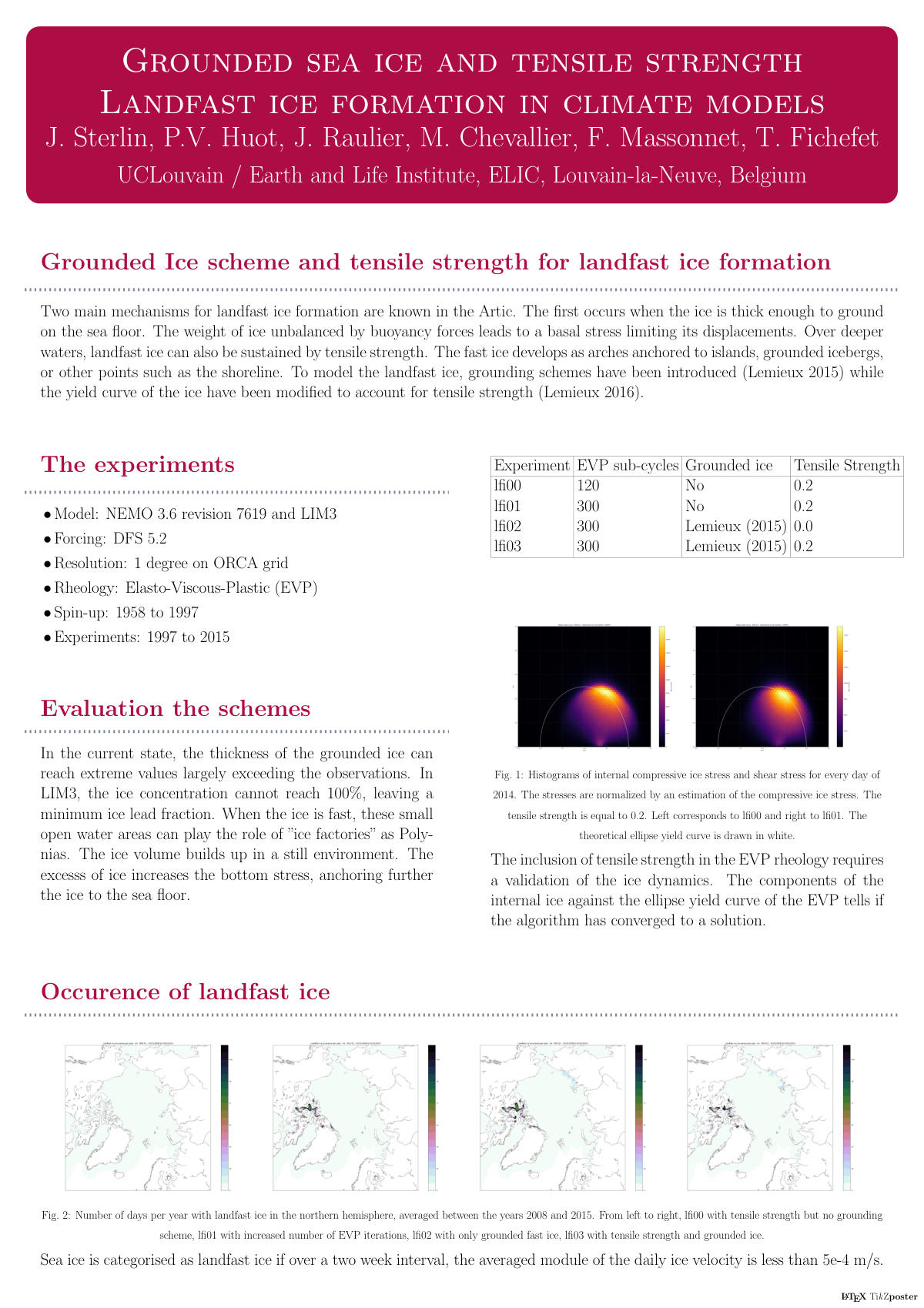
Landfast ice is the part of sea ice fastened to the coast. As the landfast ice is immobile, its has an influence on the interactions between the ocean and the atmosphere, the fresh water budgets, deep water formations and the stability of the ice cover. It plays equally a role for coastal ecosystems in the Arctic and Antarctic. Two main mechanisms for landfast ice formation are known in the Arctic. The first occurs when the ice is thick enough to ground on the sea floor. The weight of ice unbalanced by buoyancy forces leads to basal stress limiting its displacements. Over deeper waters, landfast ice can also be sustained by tensile strength. The fast ice develops as arches anchored to islands, grounded icebergs, or other points such as the shoreline. To model the landfast ice, grounding schemes have been introduced (Rousset et al., 2013; Lemieux et al., 2015) while the yield curve of the ice have been modified to account for tensile strength (Dumont et al., 2009; Lemieux et al., 2016; Olason, 2016), showing promising results for regional modelling. However, for global models, little is known on the behaviour of the grounding schemes with ice thickness distribution and coarser bathymetries, neither the effects of tensile strength on the ice dynamics at the poles, nor the impact of landfast ice on the global climate on the decadal time scale. In this study, we use NEMO-LIM3 to test Lemieux et al. (2015) grounding scheme. We introduce isotropic tensile strength in the ice rheology. We validate the representation of fast ice and the dynamic of drift ice. We then run a simulation on global ORCA grid at 1 degree resolution, from the years 1958 to 2015. We formulate an initial assessment of the importance of landfast ice for current climate models and we suggest of set of paramaters that can be used.
Conference Information
YOPP Arctic Science Workshop 2019
Identifiers
Funding Information
European Commission
Advanced Prediction in Polar regions and beyond: Modelling, observing system design and LInkages associated with ArctiC ClimATE change
Grant: 727862
Award detailsAuthors
Jean Sterlin
Université catholique de Louvain
Pierre-Vincent Huot
Université catholique de Louvain
Mathieu Chevallier
CNRM
ORCID: https://orcid.org/0000-0003-2033-166X
François Massonnet
Université catholique de Louvain
ORCID: https://orcid.org/0000-0002-4697-5781
Thierry Fichefet
Université catholique de Louvain