Description
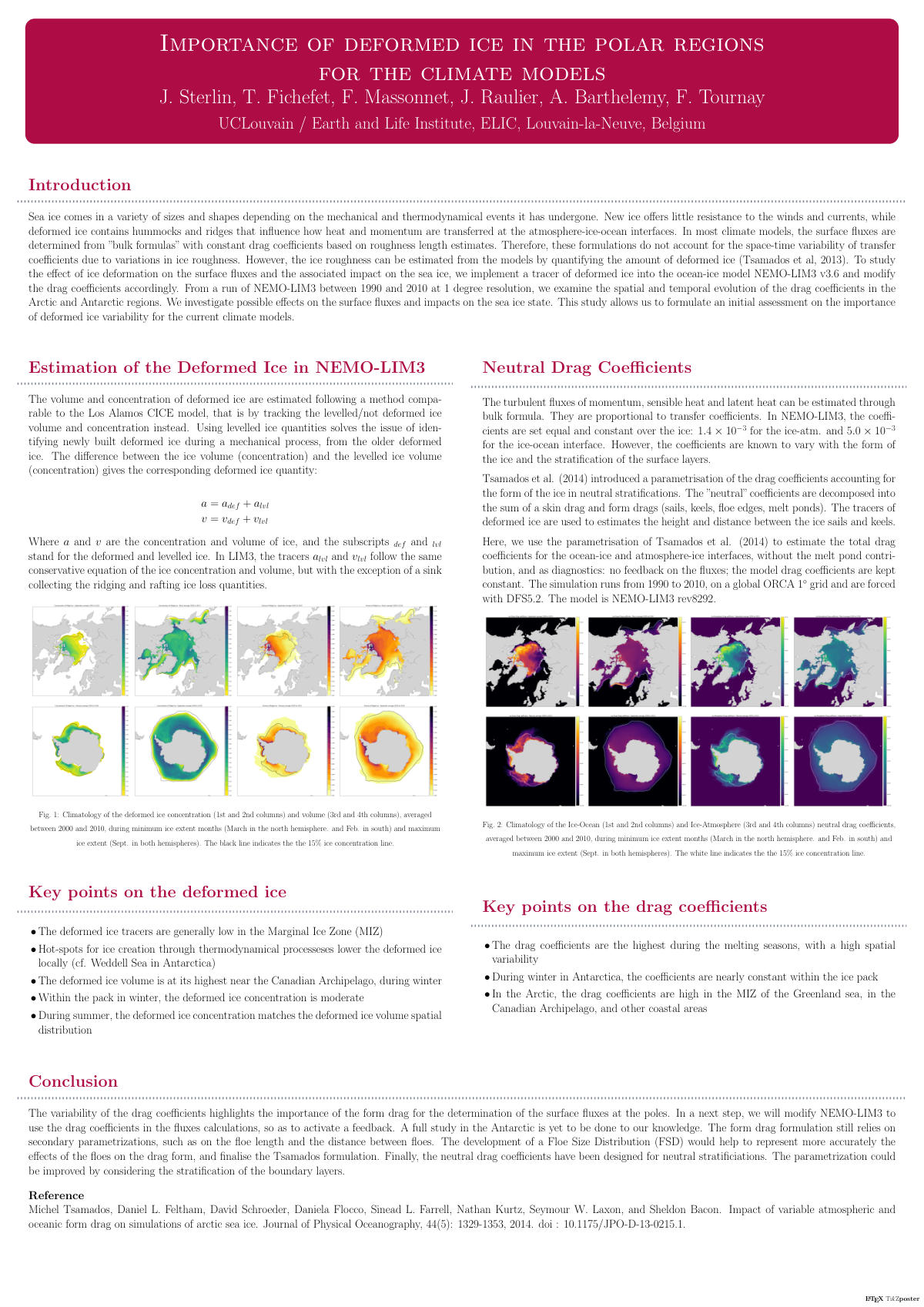
Sea ice comes in a variety of sizes and shapes depending on the mechanical and thermodynamical events it has undergone. New ice offers little resistance to the winds and currents, while deformed ice contains hummocks and ridges that influence how heat and momentum are transferred at the atmosphere-ice-ocean interfaces. In most climate models, the surface fluxes are determined from "bulk formulas" with constant drag coefficients based on roughness length estimates. Therefore, these formulations do not account for the space-time variability of transfer coefficients due to variations in ice roughness. However, the ice roughness can be estimated from the models by quantifying the amount of deformed ice (Tsamados et al, 2013). To study the effect of ice deformation on the surface fluxes and the associated impact on the sea ice, we implement a tracer of deformed ice into the ocean-ice model NEMO-LIM3 v3.6 and modify the drag coefficients accordingly. From a run of NEMO-LIM3 between 1990 and 2010 at 1 degree resolution, we examine the spatial and temporal evolution of the drag coefficients in the Arctic and Antarctic regions. We investigate possible effects on the surface fluxes and impacts on the sea ice state. This study allows us to formulate an initial assessment on the importance of deformed ice variability for the current climate models.
Conference Information
Open Science Conference OSC
Identifiers
Funding Information
European Commission
Advanced Prediction in Polar regions and beyond: Modelling, observing system design and LInkages associated with ArctiC ClimATE change
Grant: 727862
Award detailsAuthors
Jean Sterlin
Université catholique de Louvain
Thierry Fichefet
Université catholique de Louvain
François Massonnet
Université catholique de Louvain
ORCID: https://orcid.org/0000-0002-4697-5781
Jonathan Raulier
Université catholique de Louvain
Antoine Barthelemy
Université catholique de Louvain
Félicien Tournay
Université catholique de Louvain