Description
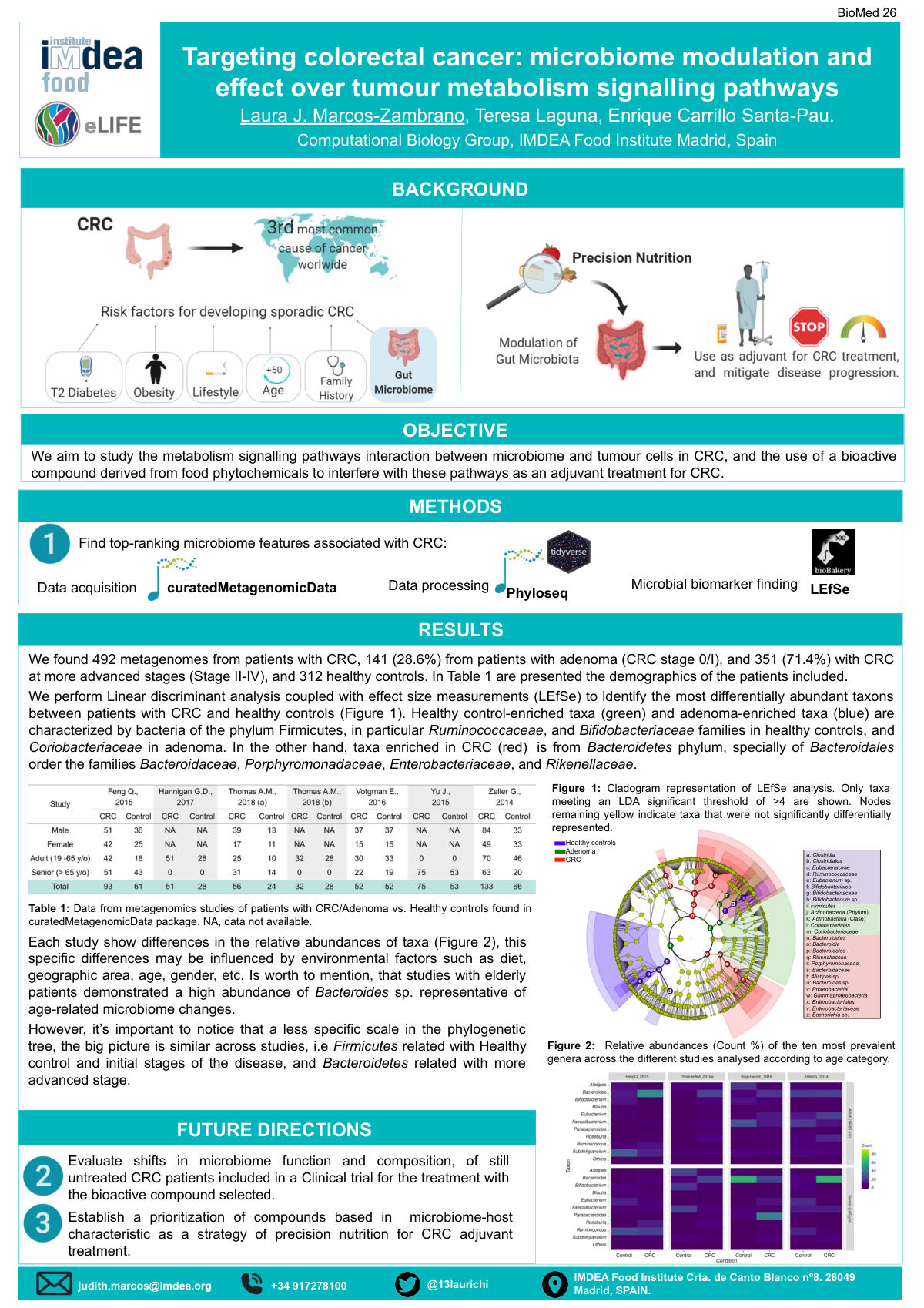
Background: Colorectal cancer (CRC) is the third most common cause of cancer worldwide, up to 10% of cases are hereditary, and the remaining 90% are sporadic. Risk factors for the development of sporadic CRC are widely described; recently, the intestinal microbiome has been pointed out as an essential factor influencing the onset and development of CRC. Moreover, it has been described changes related to the taxonomy and functionality of the microbiome according to CRC stages, and specific taxa/function present or absent according to the progression of the disease. Modulation of the microbiome and the microbial metabolites implied in CRC progression would be of great interest. In this regard, precision nutrition interventions are of interest, considering that the microbiota could be modulated through diet and nutrients. Evidence suggests that dietary supplements could act as adjuvants in the treatment and management of cancer, but the possible modulatory effect over the microbiome of patients with CRC remains unexplored. Objective: We aim to study the metabolism signalling pathways interaction between microbiome and tumour cells in CRC, and the use of a bioactive compound derived from food phytochemicals to interfere with these pathways as an adjuvant treatment for CRC. Research strategy: Characterization of the microbial metabolome of patients with CRC based in public databases: We will evaluate previously published metagenomics datasets of oral (salivary) and gut (faecal) microbiomes to establish taxa composition, diversity, functional and metabolic changes related to CRC, taking into account the top-ranking features associated with CRC compared with healthy cohorts. Determine the relationship between oral and gut metagenome and their interaction with CRC: We will select a cohort of patients with still untreated CRC admitted to Infanta Sofia Hospital, that fulfils the criteria for participating in the Clinical trial for the treatment with the bioactive compound selected. Samples of saliva and faeces will be obtained at the time of CRC diagnosis after the beginning of the treatment, and at the time treatment ends, before the surgical procedure for removing the tumour. Samples will be analyzed by shotgun metagenomics to characterize the oral and gut microbiome. We will analyze the taxonomic and the metabolic profile of the samples. Evaluation of the modulatory effect of the bioactive compounds over the metabolic profile of the microbiota and the tumour progression: We will perform a metagenomics analysis of the samples obtained at the beginning and end of the treatment with the bioactive compound to evaluate shifts in microbiota function and composition. Moreover, we will assess the presence of the microbial biomarkers related to taxa and functionality described previously and monitor changes in those parameters after the treatment.
Conference Information
Advances in Computational Biology
Identifiers
Authors
Laura Judith Marcos-Zambrano Marcos-Zambrano
Computational Biology Group, Precision Nutrition and Cancer Research Program, IMDEA Food Institute, Madrid, Spain,
ORCID: https://orcid.org/0000-0003-1381-6407
Teresa Laguna
Computational Biology Group, Precision Nutrition and Cancer Research Program, IMDEA Food Institute, Madrid, Spain,
Enrique Carrilo de Santa Pau
Computational Biology Group, Precision Nutrition and Cancer Research Program, IMDEA Food Institute, Madrid, Spain,
Enrique Carrillo Santa-Pau
Computational Biology Group, IMDEA Food Institute Madrid, Spain