Description
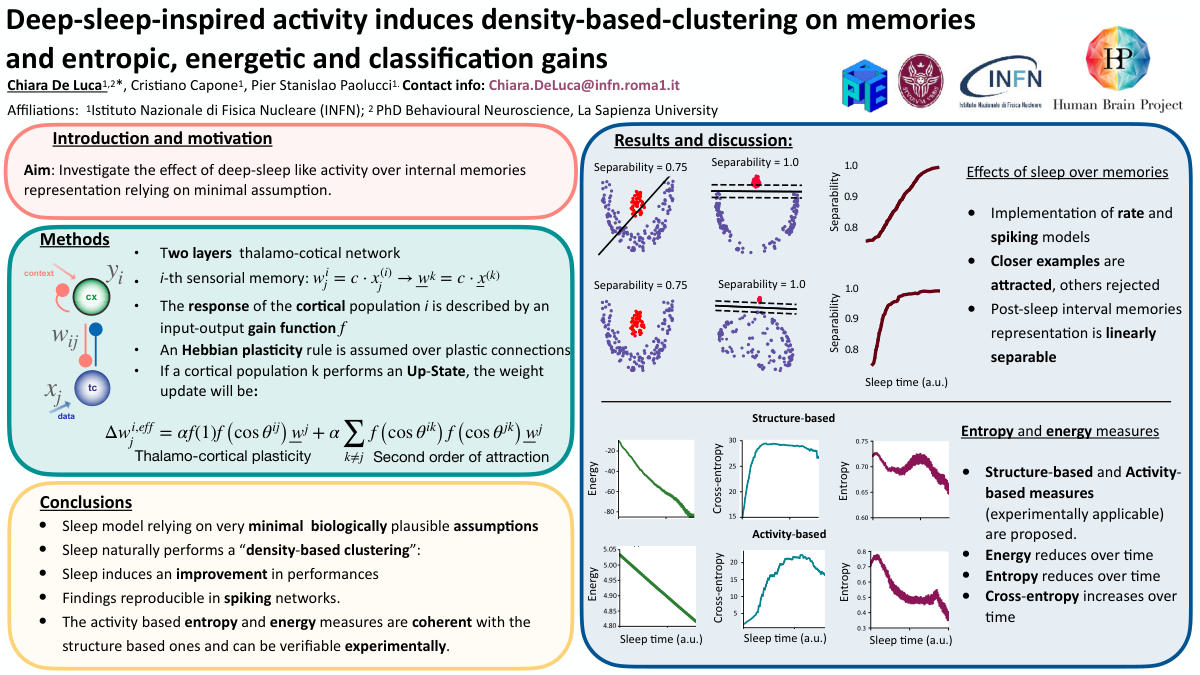
The role of sleep is known to be important but still unclear. Relying on very minimal assumptions, which are the talamo-cortical structure and the presence of cortically generated cortico-thalamic slow oscillations we formally find out that sleep might naturally perform a "density-based clustering" in the thalamo-cortical connections. The huge advantages of such clustering are: not requiring a number of clusters, finding arbitrarily shaped clusters, independence on the number of elements. This process improves the performances of visual classification tasks (e.g. MNIST). Our findings can be reproduced in spiking networks. Finally, we propose entropy-based measures, that can be applied to experimental data to verify our theoretical predictions.
Identifiers
Funding Information
Authors
Chiara De Luca
PhD Behavioural Neuroscience, La Sapienza University
ORCID: https://orcid.org/0000-0003-3488-0088
Cristiano Capone
Istituto Nazionale di Fisica Nucleare (INFN)
ORCID: https://orcid.org/0000-0002-9958-2551
Pier Stanislao Paolucci
Istituto Nazionale di Fisica Nucleare (INFN)
ORCID: https://orcid.org/0000-0003-1937-6086
Cris*ano Capone
Instituto Nazionale di Fisica Nucleare (INFN)