Description
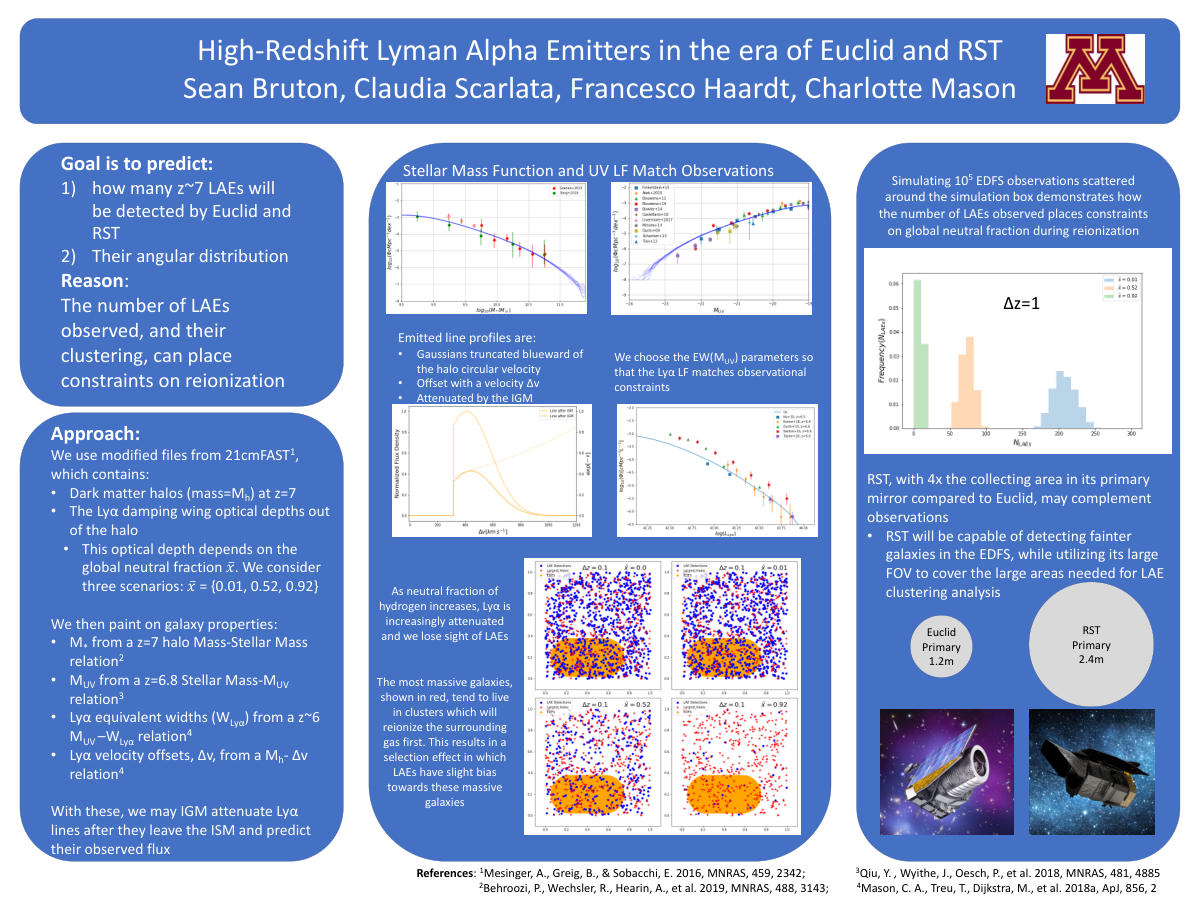
The epoch of reionization is arguably the least well known of the phase changes of the universe. It is currently the subject of much study, with researchers trying to nail down precisely how it proceeded. One promising avenue to study this question is with the topology of reionization. By studying the angular size of the first reionized bubbles of gas, we may determine which of the galaxy scenarios provided the bulk of the ionizing output. High-redshift Lyman Alpha Emitters (LAEs) may be seen only when residing in these ionized bubbles, and so can be treated as tracers of the ionized universe. We are simulating the expected spatial distribution of LAEs as will be seen in the scheduled deep fields of Euclid, a ESA space telescope mission slated to launch in 2022, in the scheduled deep fields. These 3 fields cover 40 square degrees and thus allow an angular correlation analysis over the large scales necessary to measure the topology of reionization. With a similar spectrographic wavelength coverage but 4x the primary mirror collecting area, the Roman Space Telescope will be able to detect much fainter LAEs at these high redshifts than Euclid. I will present our results for the Euclid Survey and a discussion of what these results imply for the Roman Space Telescope.
Conference Information
Galaxy Formation and Evolution in the Era of the Nancy Grace Roman Space Telescope
Identifiers
Authors
Sean Bruton
University of Minnesota
Claudia Scarlata
Francesco Haardt
Charlotte Mason