Description
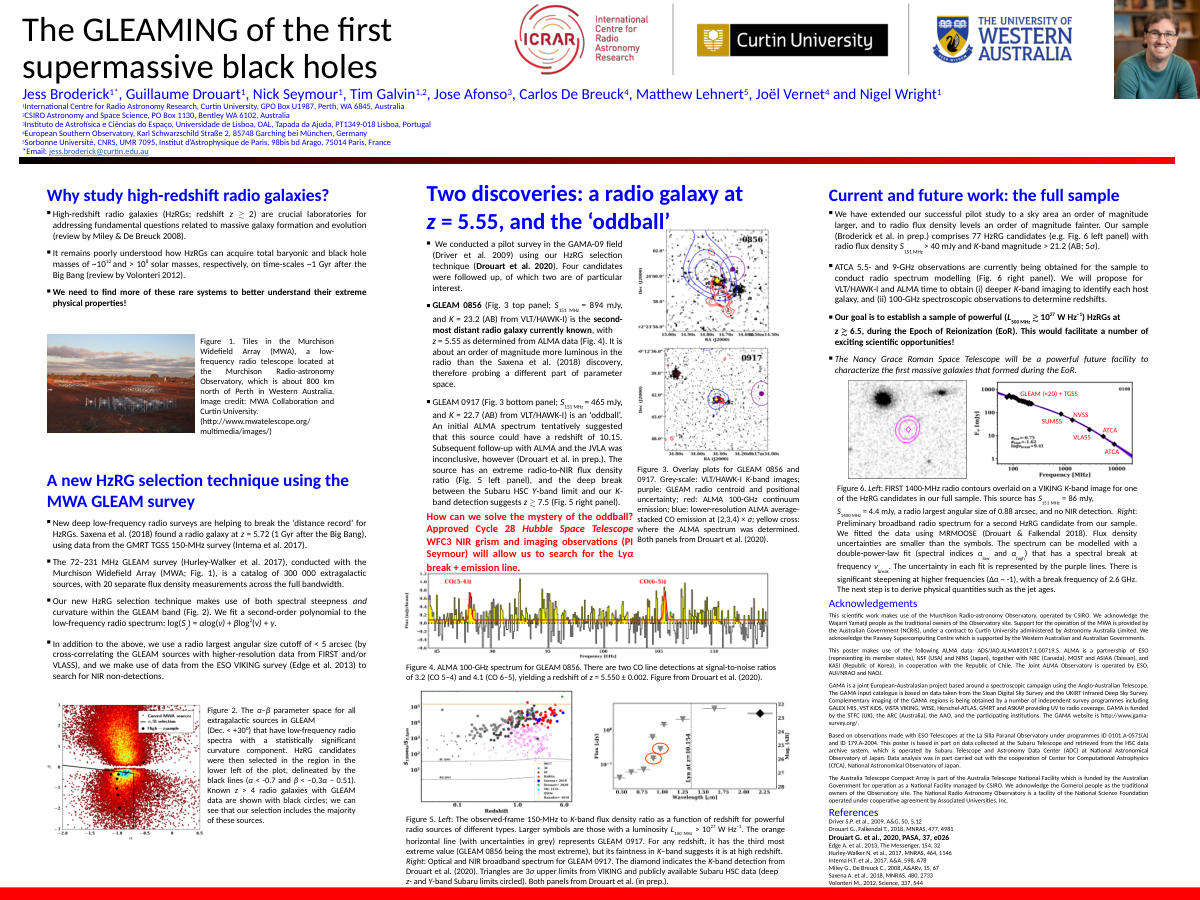
High-redshift radio galaxies (HzRGs) are vital laboratories for studying massive galaxy formation and evolution in the early Universe (see review by Miley & De Breuck, 2008, A&ARv, 15, 67). We have developed a new selection technique for finding these rare, powerful systems at z > 5, making use of spectral curvature in the Murchison Widefield Array (MWA) 70-230 MHz GLEAM survey (Hurley-Walker et al., 2017, MNRAS, 464, 1146). In a pilot study of four sources, we have discovered the second-most distant radio galaxy currently known (z=5.55; Drouart et al. 2020, PASA, 37, e026), with the exciting possibility that a second source is also at high redshift (currently being followed up with approved HST time). In this talk, I will give an overview of our pilot study, as well as ongoing work to expand our technique to a new sample of 90 HzRG candidates in the ESO VIKING near-infrared survey area. Our goal is to build a sample of Type 2 radio-loud active galactic nuclei at z > 6.5 during the Epoch of Reionization, thereby allowing us to study the co-evolution of the supermassive black hole and host galaxy during the first billion years of the Universe. This is very much a multi-wavelength project, making use of data from a variety of telescopes (e.g. MWA, VISTA, ALMA, VLT, and ATCA), and I will conclude with some thoughts on the scientific possibilities and synergies offered by the next generation of multi-wavelength facilities for the field of HzRG research.
Conference Information
Galaxy Formation and Evolution in the Era of the Nancy Grace Roman Space Telescope
Identifiers
Authors
Jess Broderick
ICRAR/Curtin University
Guillaume Drouart
International Centre for Radio Astronomy Research, Curtin University
Nick Seymour
International Centre for Radio Astronomy Research, Curtin University
Tim Galvin
International Centre for Radio Astronomy Research, Curtin University
Jose Afonso
Instituto de Astrofisica e Ciencias do Espaco, Universidade de Lisboa
Carlos De Breuck
European Southern Observatory
Matthew Lehnert
Sorbonne Universite, CNRS, UMR 7095, Institut d'Astrophysique de Paris
Joel Vernet
European Southern Observatory
Nigel Wright
International Centre for Radio Astronomy Research, Curtin University