Description
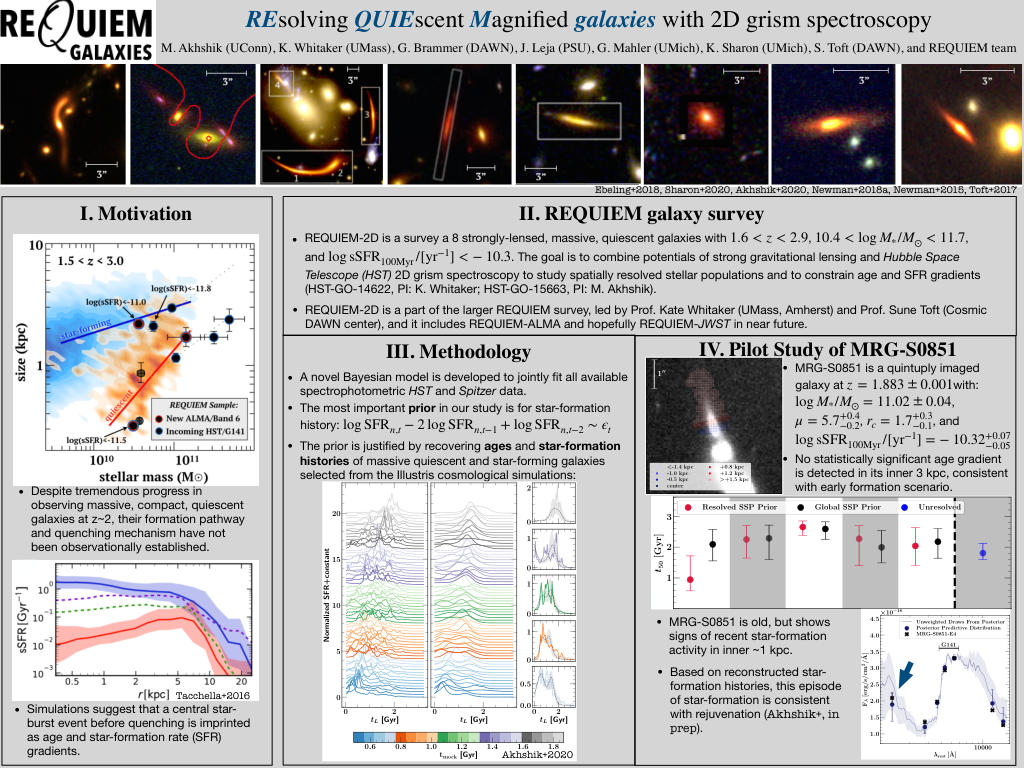
In this talk, I will present the methodology behind the new code, 'requiem2d', a Bayesian framework that combines HST 2D grism spectroscopy with HST and Spitzer photometric data to constrain the spatially resolved stellar populations and measure age and star-formation rate gradients. This code is developed for the purpose of analyzing the REQUIEM^2D Galaxy Survey, a sample of 8 strongly lensed quiescent galaxies spanning redshifts of z = 1.6 − 2.9 and stellar masses of log M* = 10.4 − 11.5. I will present tests using massive mock galaxies selected from the Illustris cosmological simulation. Furthermore, I will introduce results from our REQUIEM-2D pilot target, MRG-S0851, a gravitationally lensed quintuply imaged massive compact red galaxy at z=1.9 with a significant recent star-formation activity. Using our recovered ages and SFHs from the requiem 2d joint spectro-photometric analysis, along with trajectories in the UVJ and NUVrK color-color diagrams, we find that MRG-S0851 is consistent with an early forming, slow quenched galaxy that is going through a centrally-concentrated rejuvenation phase.
Conference Information
Galaxy Formation and Evolution in the Era of the Nancy Grace Roman Space Telescope
Identifiers
Authors
Mohammend Akshik
University of Connecticut
M. Akhshik
University of Connecticut
K. Whitaker
UMass
G. Brammer
DAWN Center for Independent Living
J. Leja
PSU
G. Mahler
University of Michigan
K. Sharon
University of Michigan
S. Toft
DAWN Center for Independent Living