Description
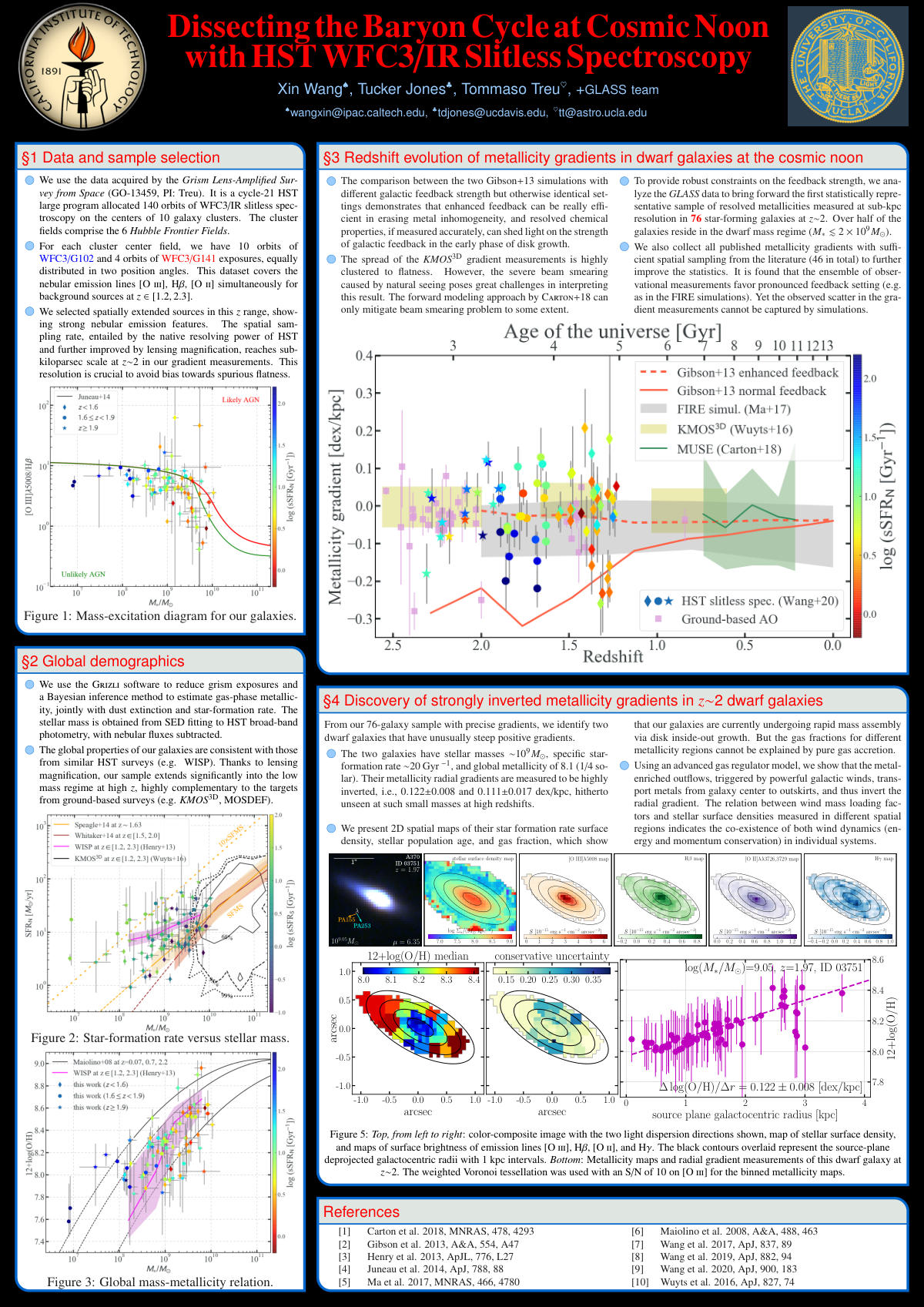
In a series of papers, we develop an efficient method for sub-kpc scale spatially resolved analysis of star-forming galaxies using wide-field slitless spectroscopy. Applying this method to the deep HST near-infrared grism observations, we obtained precise gas-phase metallicity maps for a large sample of 76 galaxies at z~2. These metallicity maps reveal a variety of baryonic physics, such as efficient radial mixing from tidal torques, rapid accretion of low-metallicity gas, and various feedback processes. For the first time, we discovered two dwarf galaxies at z~2 displaying strongly inverted radial metallicity gradients, suggesting that powerful galactic winds triggered by central starbursts carry the bulk of stellar nucleosynthesis yields to the outskirts. We measure a negative correlation between stellar mass and metallicity gradient, suggesting that strong feedback, not secular processes, is the primary governor of the chemo-structural evolution of star-forming galaxies. We also find that the intrinsic scatter of metallicity gradients increases with decreasing stellar mass and increasing specific star-formation rate. This increase in the intrinsic scatter is likely caused by the combined effect of cold-mode gas accretion and merger-induced starbursts, with the latter more predominant in the dwarf mass regime. Our method can be readily applied to the slitless spectroscopic data from future space missions, in particularly, the JWST and the Nancy Grace Roman Space Telescope.
Conference Information
Galaxy Formation and Evolution in the Era of the Nancy Grace Roman Space Telescope
Identifiers
Authors
Xin Wang
Caltech/IPAC
Tucker Jones
University of California, Davis
Tommaso Treu
University of California, Los Angeles