Description
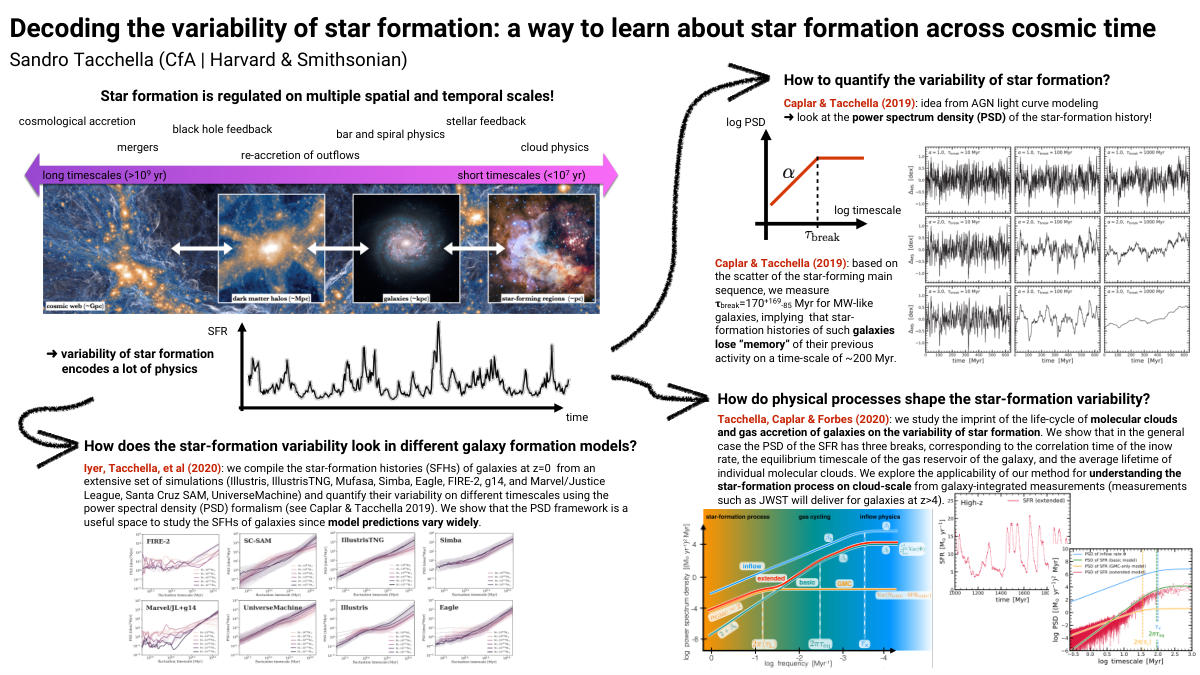
Galaxy formation theory predicts that the star-formation activity of galaxies varies with time and that these variations are related the build of structure (e.g. bulges) within galaxies. We have pushed the Hubble Space Telescope and other instruments to their limits in order to gain detailed resolved information on ~kpc scales for normal star-forming galaxies at Cosmic Noon. Nevertheless, the physics of star-formation regulation and the buildup of structure within galaxies remain uncertain. I would like to present new observational and theoretical ideas on how to link spatially resolved information to variation in star formation on integrated scales. I will start with presenting observational constraints on the spatially resolved stellar mass buildup of high-z galaxies from dust-corrected SFR density maps. I will then discuss the connection between the distributions of star formation (including the formation bulges) within galaxies with star-formation measures on global scales. Finally, I will conclude by highlighting how we can quantify the variability of star formation from large galaxy samples, such as those obtained by the Roman Space Telescope, to constrain the lifecycle of star-forming molecular clouds and gas cycling through galaxies.
Conference Information
Galaxy Formation and Evolution in the Era of the Nancy Grace Roman Space Telescope
Identifiers
Authors
Sandro Tacchella
Harvard CfA