Description
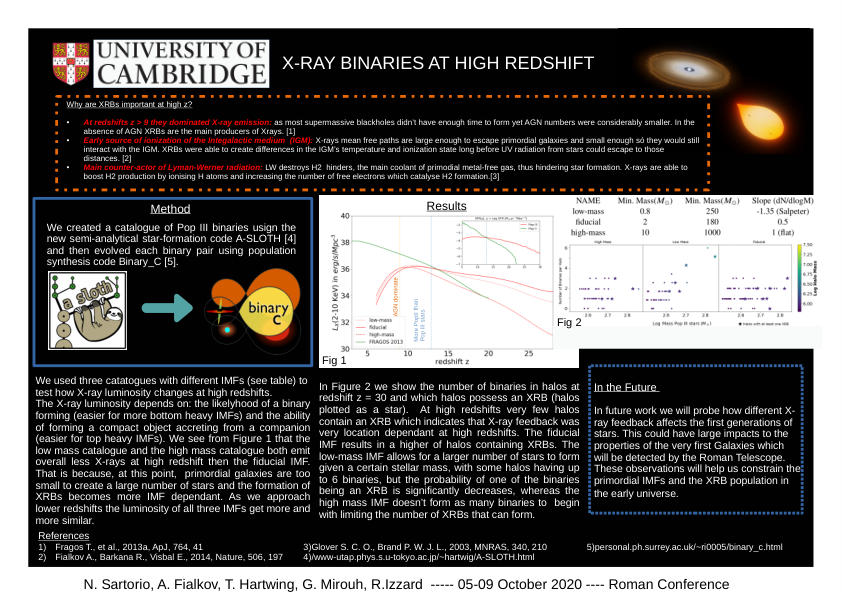
X-Ray Binaries (XRBs) are binary systems in which the primary star is a compact object (black hole or neutron star) that accretes material from its companion, emitting copious amounts of X-rays in the process. These binaries are key in studying primordial star formation. XRBs are generally subdivided into binaries according to the mass of the secondary star. XRBs with high mass companions (HMXBs), due to the brevity of their existence, are good tracers of the star formation rate (SFR). The information of XRBs with low mass secondaries (LMXBs) can also give us an insight into the primordial IMF. Furthermore, X-ray emission increases the fraction of free electrons, which are catalysts for the formation of the main coolant for primordial gas: molecular hydrogen. This way, X-rays can help increase H2 abundance and facilitate star formation in metal free gas. We study the formation of XRBs, differentiating between LMXBs and HMXBs in Population III stars in minihalos using the population synthesis code Binary_C. We evolve thousands of binary systems through redshifts 30 until 15 for three different initial mass functions (top heavy, bottom heavy and flat). We analyse how XRB abundance varies over time, obtaining constraints for the X-ray background in the early universe for each of the modeled cases. In addition, we trace the number of XRBs that are LMXBs and HMXBs and analyse how we can recover clues about the early IMF and SFR from current observations.
Conference Information
Galaxy Formation and Evolution in the Era of the Nancy Grace Roman Space Telescope
Identifiers
Authors
Nina Sartorio
Cambridge
A. Fialkov
The University of Tokyo
T. Hartwig
The University of Tokyo
G. Mirouh
The University of Tokyo
R. Izzard
The University of Tokyo