Description
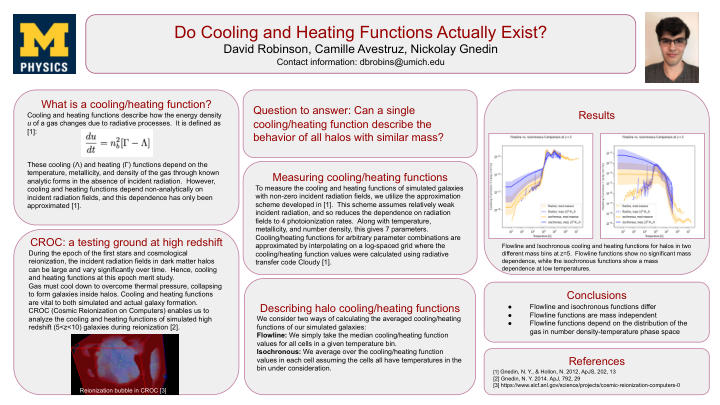
Cooling and heating functions for cosmic gas control how the baryonic content of galaxies evolves with time. Previous work has established that these functions depend on both gas properties (e.g. temperature, density, metallicity) and the radiation field incident on the gas, and hence may vary substantially inside a galaxy and between the phases of the ISM. Can a single set of a cooling and a heating function give a good description of the thermodynamics of the ISM? To answer this question, we use simulations from the CROC project (Cosmic Reionization on Computers). These simulations self-consistently model large scale structure formation, hydrodynamics, cosmology, and the reionization process. We find that there is no single cooling or heating function that describes the thermal properties of simulated galaxies; instead, as the hotter, dense gas cools down to the cold phase, its cooling function changes substantially and the resulting cooling rate as a function of temperature is not described by any single cooling function. The same (but in reverse) applies to the gas being heated by stellar feedback. We conclude that fixed cooling and heating functions computed from, say, Cloudy for a fixed set of physical parameters, give an inaccurate description to the actual cooling and heating rates experienced by the thermally evolving ISM gas.
Conference Information
Galaxy Formation and Evolution in the Era of the Nancy Grace Roman Space Telescope
Identifiers
Authors
David Robinson
U Michigan
Camille Avestruz
Nickolay Gnedin