Description
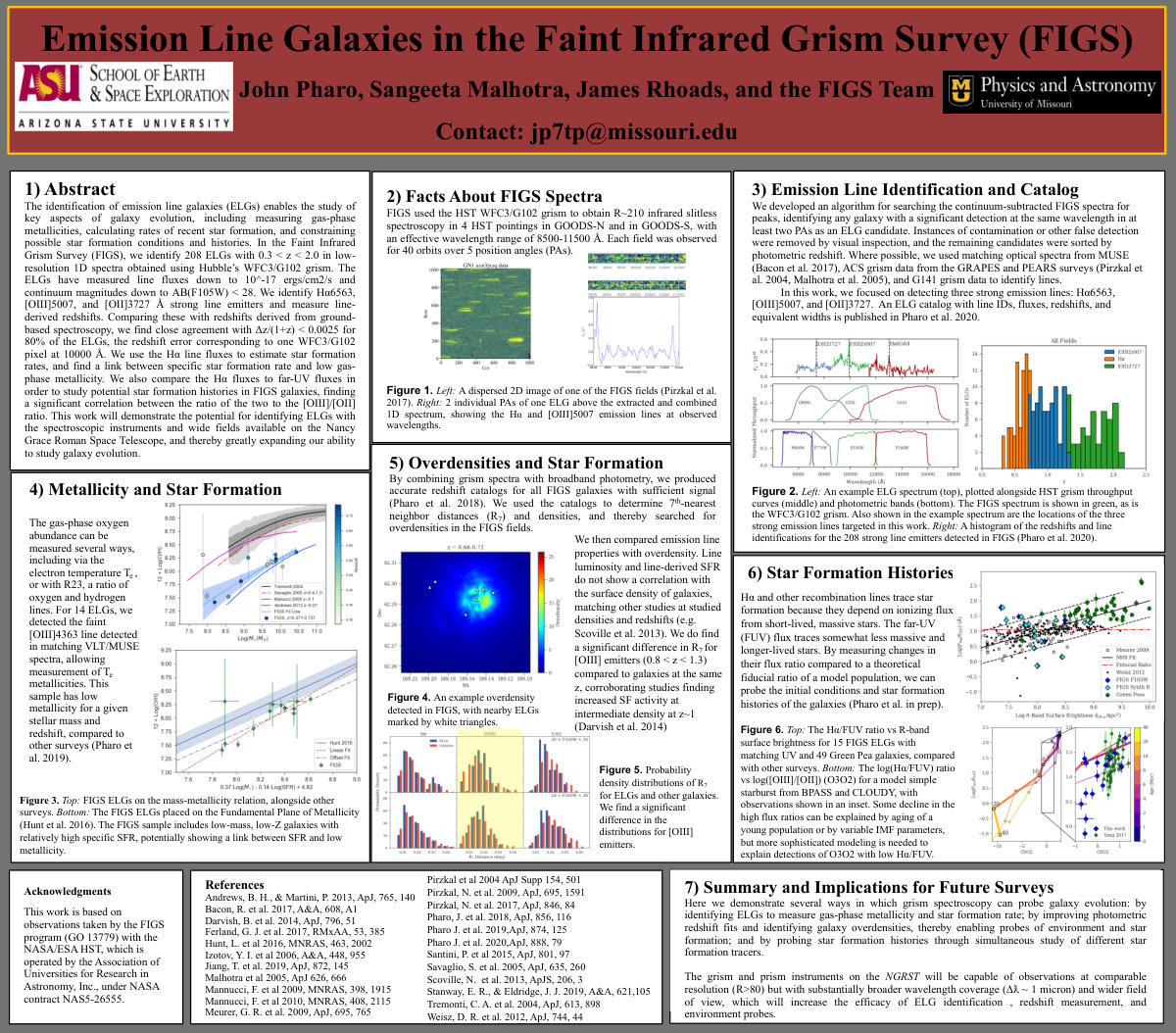
The identification of emission line galaxies (ELGs) enables the study of key aspects of galaxy evolution, including measuring gas-phase metallicities, calculating rates of recent star formation, and constraining possible star formation conditions and histories. In the Faint Infrared Grism Survey (FIGS), we identify 208 ELGs with 0.3 < z < 2.0 in low-resolution 1D spectra obtained using Hubble’s WFC3/G102 grism. The ELGs have measured line fluxes down to 10^-17 ergs/cm2/s and continuum magnitudes down to AB(F105W) < 28. We identify Hα6563, [OIII]5007, and [OII]3727 Å strong line emitters and measure line-derived redshifts. Comparing these with redshifts derived from ground-based spectroscopy, we find close agreement with Δz/(1+z) < 0.0025 for 80% of the ELGs, the redshift error corresponding to one WFC3/G102 pixel at 10000 Å. We use the Hα line fluxes to estimate star formation rates, and find a link between specific star formation rate and low gas-phase metallicity. We also compare the Hα fluxes to far-UV fluxes in order to study potential star formation histories in FIGS galaxies, finding a significant correlation between the ratio of the two to the [OIII]/[OII] ratio. This work will demonstrate the potential for identifying ELGs with the spectroscopic instruments and wide fields available on the Nancy Grace Roman Space Telescope, and thereby greatly expanding our ability to study galaxy evolution.
Conference Information
Galaxy Formation and Evolution in the Era of the Nancy Grace Roman Space Telescope
Identifiers
Authors
John Pharo
U Missouri
Sangeeta Malhotra
James Rhoads
FIGS Team