Description
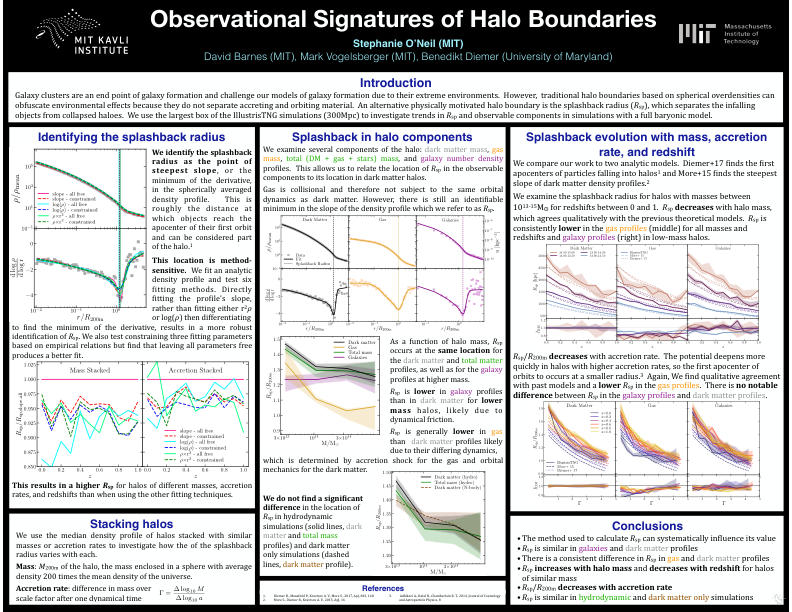
Galaxy clusters represent the terminus of galaxy formation and present the ultimate challenge to our theories of structure formation. However, our understanding of the impact of cluster environments defined by traditional spherical overdensities is complicated by the fact that accreting and orbiting galaxies are mixed beyond the assumed halo boundary. An alternative halo boundary is the splashback radius, which separates the infalling objects from collapsed halos. In this talk, I will present a comparison of splashback boundaries derived from dark matter and galaxy density profiles for groups and clusters in the IllustrisTNG simulations. I will highlight that observable components, like galaxies, are reliable tracers of the underlying dark matter profiles, making future detections of this splashback radius with the Nancy Grace Roman Space Telescope an enticing prospect. I will then explore differences between the hydrodynamic simulations and the dark matter-only runs used for the vast majority of previous studies. Finally, I will demonstrate how the splashback radius changes as a function of halo mass, accretion rate, redshift, and method used to identify splashback features.
Conference Information
Galaxy Formation and Evolution in the Era of the Nancy Grace Roman Space Telescope
Identifiers
Authors
Stephanie O'Neil
Massachusetts Institute of Technology
David Barnes
MIT
Mark Vogelsberger
MIT
Benedikt Diemer
University of Maryland