Description
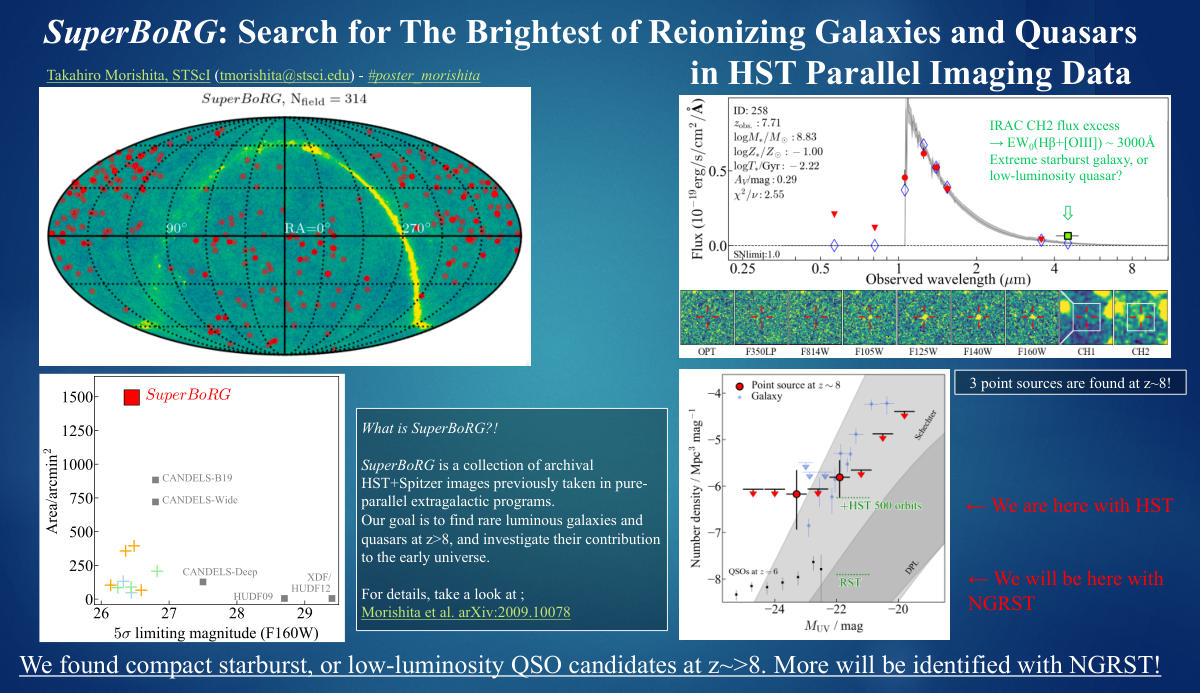
The formation of the first generation of quasars and galaxies has been one of the top priority subjects in astronomy today. Such objects in the early universe play the key role in the cosmic (re-)ionization history, and thus their identification is of critical interest. In this contribution, we present results from SuperBoRG, a project compiling all data taken with HST pure-parallel surveys in the past decade. From ~300 independent sightlines (~0.3deg2 in total area), we identified a number of luminous candidates at 8<z<11, including three low-luminosity QSO candidates. Spectroscopic and Spitzer followups revealed extreme nature of one of the QSO candidates. The volume explored here is, however, still not sufficient to find a luminous QSO. The Roman Space Telescope will reach the sufficient volume with half of the observing time here with HST, and successfully characterize luminosity functions of QSOs and luminous galaxies at z>8.
Conference Information
Galaxy Formation and Evolution in the Era of the Nancy Grace Roman Space Telescope
Identifiers
Authors
Takahiro Morishita
STScI