Description
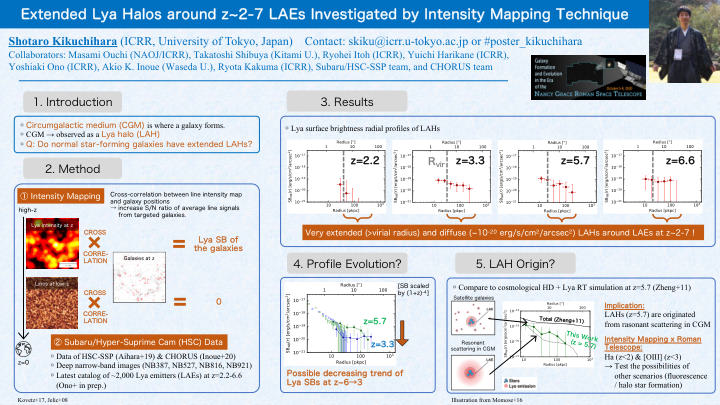
We present extended Lya halo (LAH) profiles of z~2-7 Lya emitters (LAEs) that are derived by intensity mapping technique. We make a sample of total ~2000 LAEs at z=2.2, 3.3, 5.7, and 6.6 in the COSMOS field with the latest ultra-deep narrow-band (NB) and broad-band images of Subaru/Hyper Suprime-Cam (HSC) surveys, exploiting a machine learning selection algorithm. We take cross-correlation between positions of the LAEs and Lya intensity of the NB images to measure the Lya surface brightness (SB) of the LAEs, finding that the Lya SB profiles are extended up to >~200 comoving kpc at z~2-7 beyond the virial radius. We also find the possible decreasing trend of the profiles towards lower-redshift, if the cosmological dimming effect is corrected. Being compared with Lya radiative transfer simulations near the epoch of reionization, our results at z~6 favor the resonant scattering in the circumgalactic medium. We will also discuss the prospects of intensity mapping studies with the spectroscopic data of the Nancy Grace Roman Space Telescope/Wide Field Instrument, which will enable us to investigate SB profiles of Lya, Ha, [OIII], and [OII] with much less sky background than ground-based observations. Comparing these profiles will provide hints for the origin of ionized and neutral gas distributions around high-redshift star-forming galaxies.
Conference Information
Galaxy Formation and Evolution in the Era of the Nancy Grace Roman Space Telescope
Identifiers
Authors
Shotaro Kikuchihara
U.Tokyo
Masami Ouchi
NAOJ/ICRR
Takatoshi Shibuya
Kitami U.
Ryohei Itoh
ICRR
Yuichi Harikane
ICRR
Yoshiaki Ono
ICRR
Akio K. Inoue
Waseda U.
Ryota Kakuma
ICRR
Subaru/HSC-SSP team
CHORUS team