Description
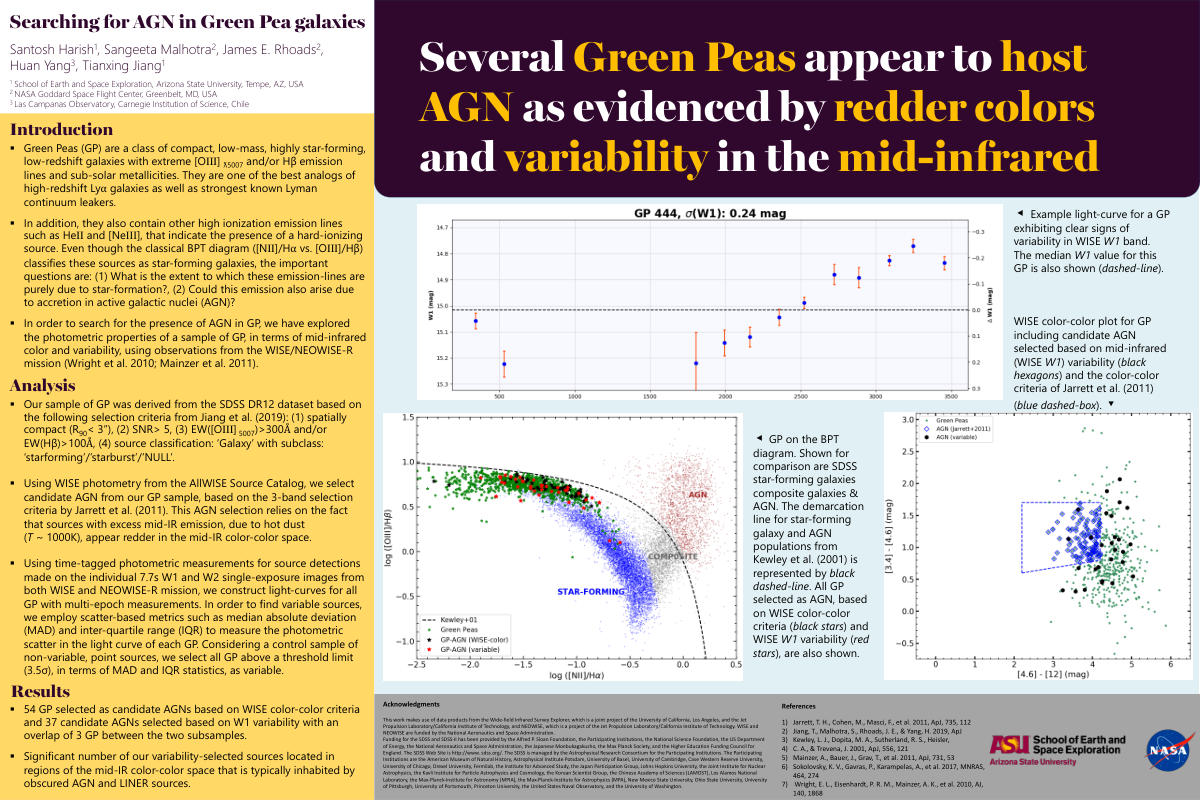
Green Peas (GP) are a class of low-redshift galaxies with extreme emission lines. They are considered to be the best analogs of high-redshift Lyman-alpha galaxies as well as strongest known Lyman continuum leakers. In addition, they also contain other high ionization emission lines such as HeII and [NeIII], that indicate the presence of a hard ionizing source. With a quest to determine the extent to which these emission lines are powered by star-formation and/or accretion due to active galactic nuclei, we have searched for AGN in GPs based on mid-infrared colors and variability from WISE. We found that the AGN candidates selected by each of these methods can be quite different, although some overlap exists. Through this work, we highlight the importance of employing variability as a diagnostic in selecting AGN candidates that can be optically-hidden, obscured and/or low-luminosity AGN. In the near future, the Roman Space Telescope will produce one of the largest datasets of galaxies and AGN, thanks to the large field-of-view. With multi-epoch observations targeted by the high latitude surveys, it will be possible to measure near-IR variability of AGN sources across various redshifts. These data will be crucial in better understanding the starburst-AGN connection in such extreme galaxies and determining the contribution of faint AGNs towards ionization at those redshifts.
Conference Information
Galaxy Formation and Evolution in the Era of the Nancy Grace Roman Space Telescope
Identifiers
Authors
Santosh Harish
Arizona State University
Sangeeta Malhotra
NASA Goddard Space Flight Center, Greenbelt, MD, United States
James E. Rhoads
NASA Goddard Space Flight Center, Greenbelt, MD, United States
Huan Yang
Las Campanas Observatory
Tianxing Jiang
Arizona State University