Description
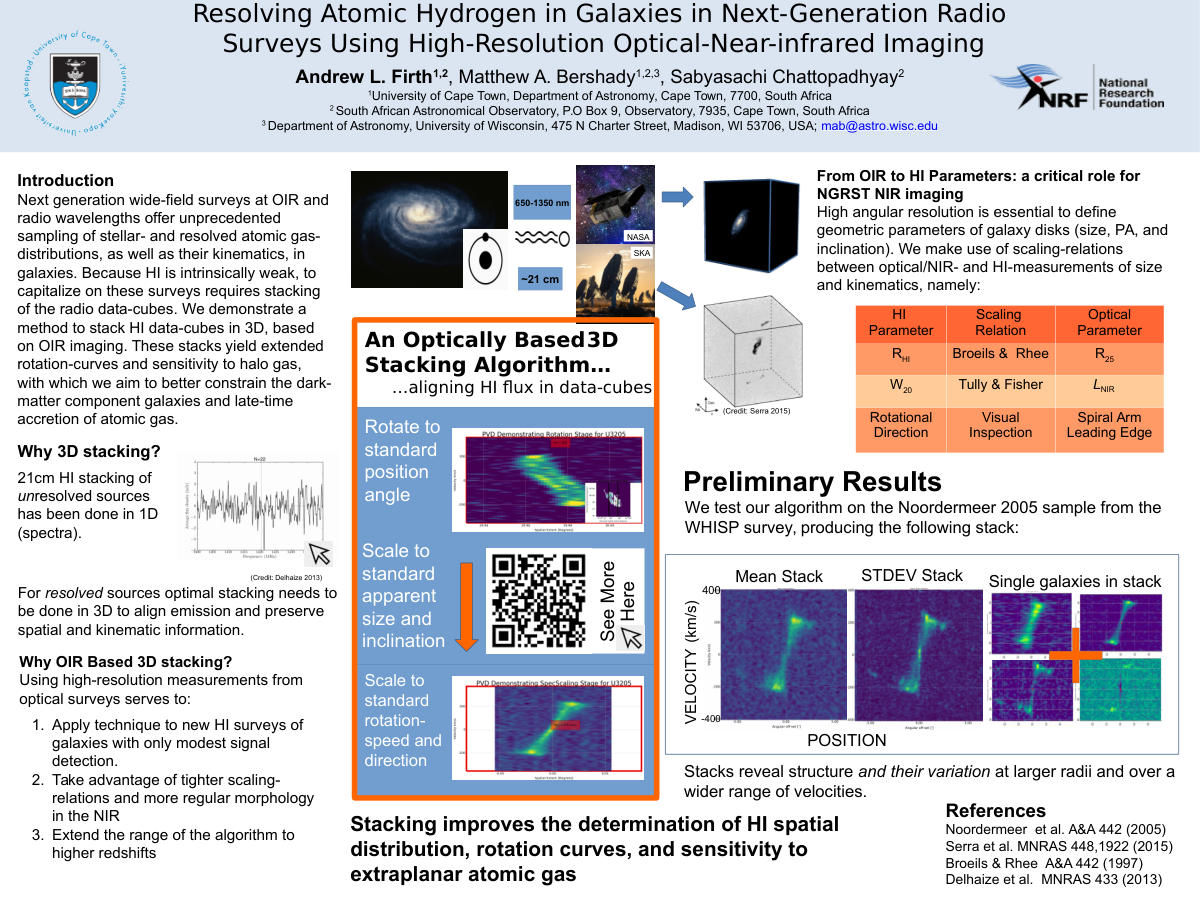
Multi-wavelength analyses of galaxies is a vital component of studying galaxy evolution. In the radio regime, the intrinsically weak flux of the neutral hydrogen (HI) signal often requires stacking of multiple sources; this has become commonplace for the statistical detection of HI line profiles in deep-fields from SKA precursor-surveys. In contrast, we are developing algorithms for 3D data-cube stacking to take advantage of wide-field surveys to study the resolved spatial distribution and kinematics of neutral hydrogen at moderate redshifts. Our aim is to develop a stacking algorithm based solely on optical and near-infrared (OIR) measurements. These OIR measurements are used to infer HI properties through a variety of well-known scaling relations, with the addition of shape parameters that better characterize both spatial and spectral distributions of HI emission. The algorithm makes use of these scalings to co-align galaxies’ flux distributions in 3D prior to stacking. We demonstrate our algorithm using WHISP 21-cm data-cubes and ground-based imaging of nearby galaxies. The algorithm will be applied to HI deep-fields with HST imaging (e.g., CHILES/COSMOS and LADUMA/GEMS). In basing the algorithm on measurements of galaxy parameters done in the OIR regime, we hope to utilise the high-SNR, high-resolution and widely-mapped regions of the sky made available by the Nancy Grace Roman Space Telescope.
Conference Information
Galaxy Formation and Evolution in the Era of the Nancy Grace Roman Space Telescope
Identifiers
Authors
Andrew L. Firth
U Cape Town
Matthew A. Bershady
University of Cape Town
Sabyasachi Chattopadhyay
University of Cape Town