Description
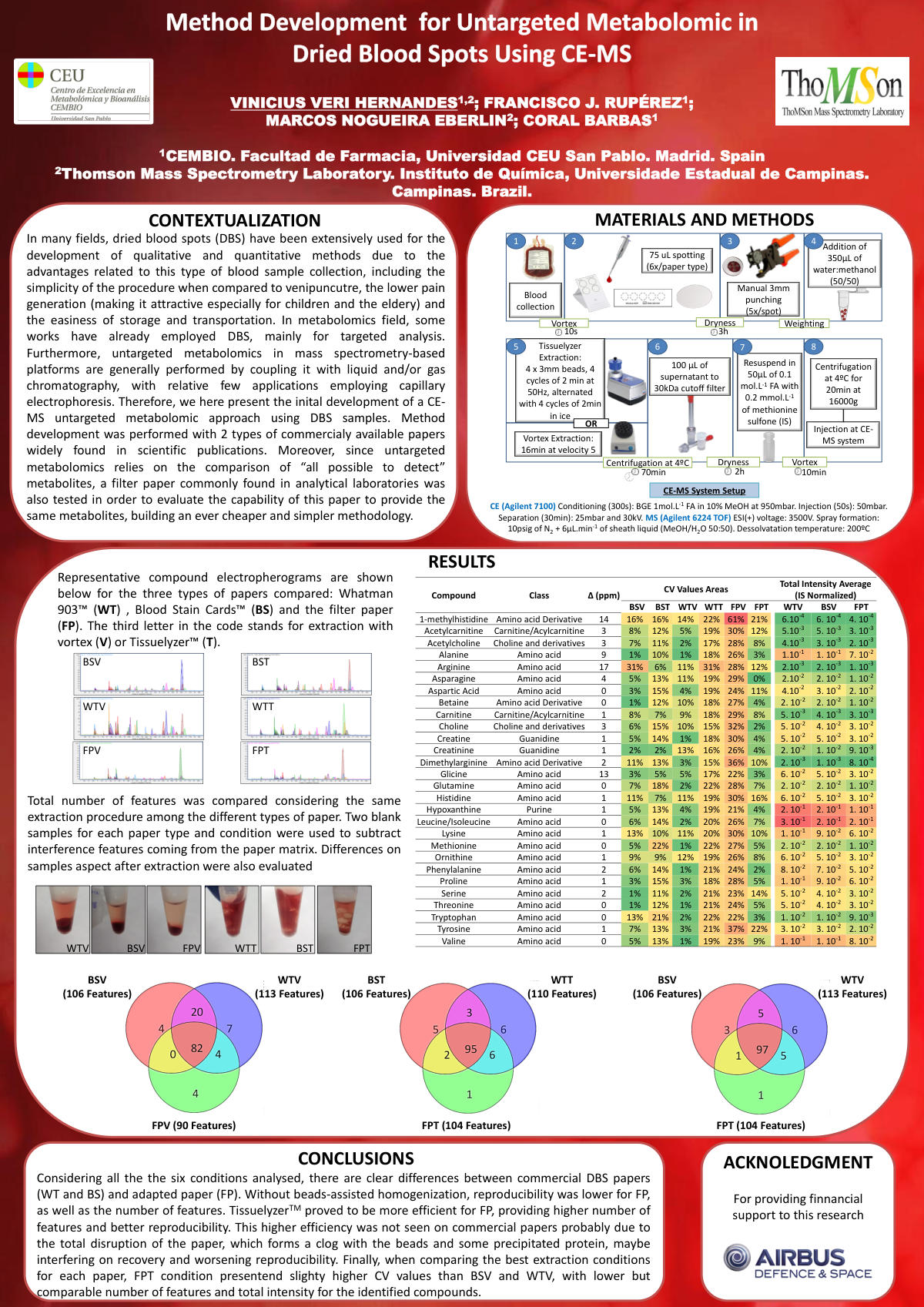
Dried blood spots (DBS) have been present on clinical analysis for more than 100 years with highlighted application on the assessment of inherited metabolic disorders in newborns (currently, 95% of all newborns in United States are screened1 for more than 50 conditions2). Recently, DBS have been considered for many new applications mainly due to the easier and smoother collection procedure when compared to intravenous blood uptake and the facilitated transportation and storage. On the other hand, issues that are absent when working with plasma or serum samples must be considered when developing a method with the use of DBS, i.e the hematocrit effect due to the interindividual variability of red blood cells level, the impact of the substrate and the stability of compounds during storage3. Metabolomics is a recent field of study which has derived from the “omics” platforms: as genomics may be defined in a simple way as “the study of the genes”, similar is for metabolomics as “the study of the metabolites” in a specific specimen. For that, basically two different approaches can be employed: selecting a set of metabolites for analysis with known relation to the scientific question to answer – known as “target metabolomics” - or analyzing the largest number of metabolites, from a diversity of chemical and biological classes, referred as “untarget metabolomics”. For both cases, mass spectrometry and nuclear magnetic resonance are the most employed techniques. Ideally, for target metabolomics, the technique of choice would be the one which can better analyze your set of pre-selected metabolites. For untarget, any technique can be chosen, always keeping in mind that each one of them will detect metabolites with distinct chemical characteristics - mainly for MS where the analysis can be performed with direct infusion or coupled with separation techniques such as liquid (LC-MS) or gas chromatography (GC-MS) and capillary electrophoresis (CE-MS). With this in mind, and considering that the majority of the works reported until now employed DBS in target studies, we here present the optimization of an untarget metabolomic methodology for the analysis of DBS using CE-MS. From all the separations techniques coupled with mass spectrometry, CE-MS is the least employed much likely due to the fact that many issues had to be worked around to permit this coupling, making it commercially available much latter. Besides, it is the less reproducible in terms of migration time (compared to retention time in LC-MS and GC-MS), which hampered the alignment of peaks in early softwares. Today, it is a complementary tool in the characterization of many metabolites, urging the need for standardized protocols. Herein we compared a novel extraction method employing Tissuelyzer with vortex extraction evaluating output parameters such as total number of features and features variation coefficient as well as performing univariate and multivariate statistics.
Identifiers
Authors
Vinicius Veri Hernandes
CEMBIO. Facultad de Farmacia, Universidad CEU San Pablo, Madrid, Spain
ORCID: https://orcid.org/0000-0002-3057-6460
Francisco Javier RUPEREZ
CEMBIO. Facultad de Farmacia, Universidad CEU San Pablo, Madrid, Spain
Marcos Nogueira Eberlin
Thomson Mass Spectrometry Laboratory. Instituto de Quimica, Universidade Estadual de Campinas. Campinas. Brazil.
Coral Barbas
CEMBIO. Facultad de Farmacia, Universidad CEU San Pablo, Madrid, Spain