Description
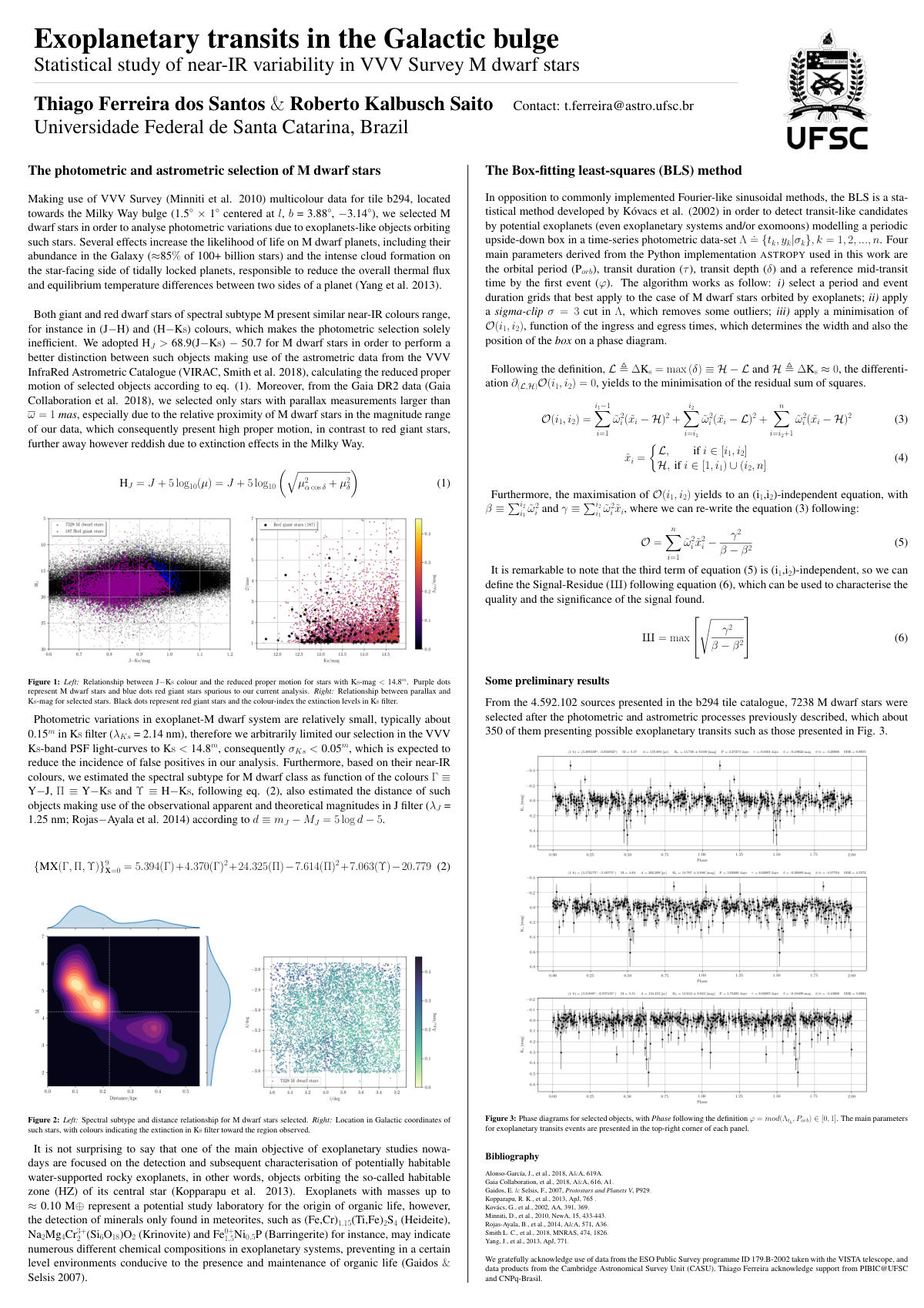
The search and detection of exoplanets orbiting red dwarf stars are one of the main objectives of the VVV & VVV-X surveys, whence has been observed in near-IR bands the region of the bulge and Galactic disk during the last decade. At first, we selected dwarf stars based on PSF photometry data and distinguished red dwarfs from giant stars, spurious to our current analysis, using astrometric data from the VIRAC and Gaia DR2 projects. This particular type of star becomes of great interest in exoplanetary studies due to its relative low dimensions and temperatures, which maximizes researches on potentially habitable rocky exoplanets orbiting such stars. Subsequently, we searched for periodic light variations by implementing the box-fitting and the Lomb-Scargle methods in order to detect such exoplanets transits. Through parameters such as depth, transit width and orbital period, as well as knowing the spectral subtype of the central star, besides determining its distance, it is possible to estimate the dimensions of the exoplanet, or even exoplanetary systems, as to radius, surface temperature and mass, important factors in the characterization of an exoplanet as to its habitability.
Conference Information
Planets 2020, Ground and space observatories: a joint venture to planetary science.
Identifiers
Authors
Thiago Ferreira dos Santos
Universidade Federal de Santa Catarina, Brazil
Roberto Kalbusch Saito
Universidade Federal de Santa Catarina, Brazil