Description
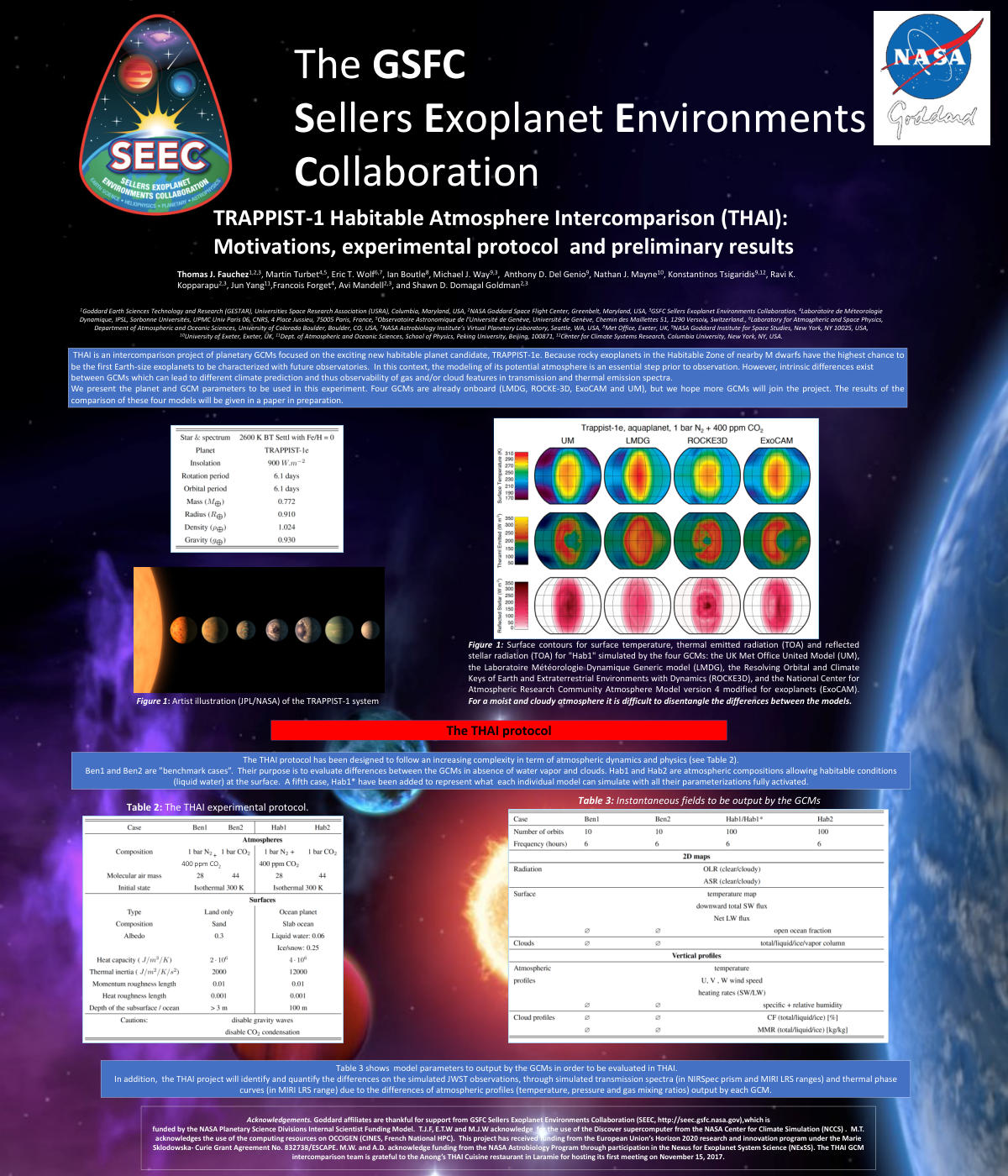
Upcoming telescopes such as the James Webb Space Telescope (JWST), the European Extremely Large Telescope (E-ELT), the Thirty Meter Telescope (TMT) or the Giant Magellan Telescope (GMT) may soon be able to characterize, through transmission, emission or reflection spectroscopy, the atmospheres of rocky exoplanets orbiting nearby cool stars called M dwarfs. In this context, the modeling of its potential atmosphere is an essential step prior to observation. Global Circulation Models (GCMs) offer the most detailed way to simulate planetary atmospheres. However, intrinsic differences exist between GCMs which can lead to different climate prediction and thus different estimation of the detectability of exoplanet atmospheres. We present a protocol to inter-compare planetary GCMs and present the first results of the intercomparison using the TRAPPIST-1e planet as a benchmark. Currently, there are four participating models (LMDG, ROCKE-3D, ExoCAM, UM), however this protocol is intended to let other teams participate as well.
Conference Information
Planets 2020, Ground and space observatories: a joint venture to planetary science.
Identifiers
Authors
Thomas J. Fauchez
Goddard Earth Sciences Technology and Research (GESTAR), Universities Space Research Association (USRA), Columbia, Maryland, USA
Martin Turbet
Place Jussieu, France, Observatoire Astronomique de l'Université de Genève
Eric T. Wolf
Laboratory for Atmospheric and Space Physics, Department of Atmospheric and Oceanic Sciences, University of Colorado Boulder
Ian Boutle
Met Office
Michael J. Way
NASA Goddard Institute for Space Studie
Anthony D. Del Genio
NASA Goddard Institute for Space Studie
Nathan J. Mayne
University of Exeter, UK
Konstantinos Tsigaridis
NASA Goddard Institute for Space Studies
Ravi K. Kopparapu
NASA Goddard Space Flight Center, Greenbelt
Jun Yang
Dept. of Atmospheric and Oceanic Sciences, School of Physics, Peking University
Francois Forget
Laboratoire de Méteorologie Dynamique, IPSL, Sorbonne Universités
Avi Mandell
NASA Goddard Space Flight Center, Greenbelt
Shawn D. Domagal Goldman
NASA Goddard Space Flight Center, Greenbelt