Description
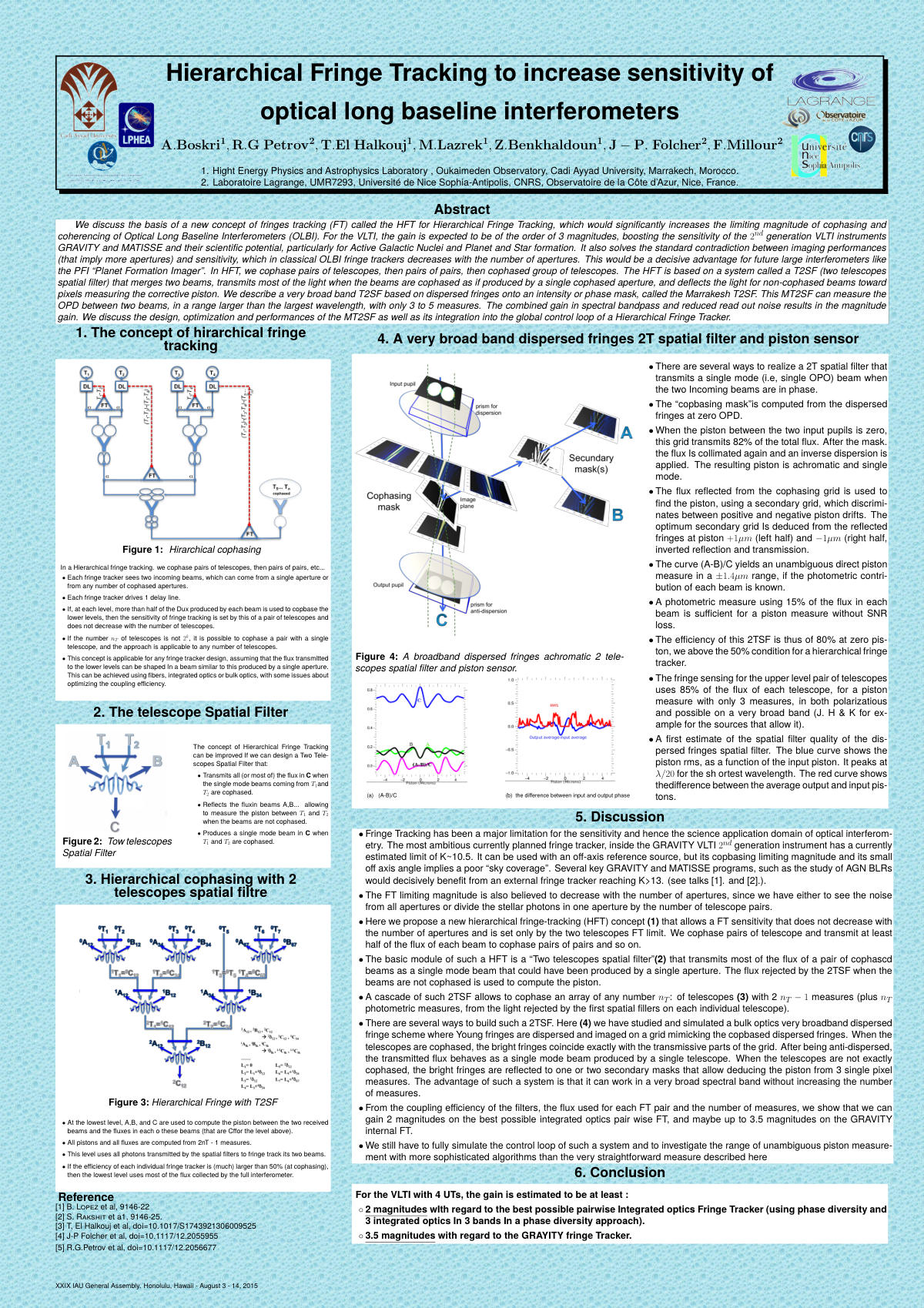
We discuss the basis of a new concept of fringes tracking (FT) called the HFT for Hierarchical Fringe Tracking, which would significantly increases the limiting magnitude of cophasing and coherencing of Optical Long Baseline Interferometers (OLBI). For the VLTI, the gain is expected to be of the order of 3 magnitudes, boosting the sensitivity of the 2 nd generation VLTI instruments GRAVITY and MATISSE and their scientific potential, particularly for Active Galactic Nuclei and Planet and Star formation. It also solves the standard contradiction between imaging performances (that imply more apertures) and sensitivity, which in classical OLBI fringe trackers decreases with the number of apertures. This would be a decisive advantage for future large interferometers like the PFI “Planet Formation Imager”. In HFT, we cophase pairs of telescopes, then pairs of pairs, then cophased group of telescopes. The HFT is based on a system called a T2SF (two telescopes spatial filter) that merges two beams, transmits most of the light when the beams are cophased as if produced by a single cophased aperture, and deflects the light for non-cophased beams toward pixels measuring the corrective piston. We describe a very broad band T2SF based on dispersed fringes onto an intensity or phase mask, called the Marrakesh T2SF. This MT2SF can measure the OPD between two beams, in a range larger than the largest wavelength, with only 3 to 5 measures. The combined gain in spectral bandpass and reduced read out noise results in the magnitude gain. We discuss the design, optimization and performances of the MT2SF as well as its integration into the global control loop of a Hierarchical Fringe Tracker
Conference Information
XXIX IAU General Assembly
Identifiers
Authors
abdelkarim Boskri
Hight Energy Physics and Astrophysics Laboratory , Oukaimeden Observatory, Cadi Ayyad University, Marrakech, Morocco
ORCID: https://orcid.org/0000-0002-7370-9737
Romain G Petrov
Laboratoire Lagrange, UMR7293, Université de Nice Sophia-Antipolis, CNRS, Observatoire de la Côte d'Azur, Nice, France.
Mohamed Lazrek
Hight Energy Physics and Astrophysics Laboratory , Oukaimeden Observatory, Cadi Ayyad University, Marrakech, Morocco
Zouhair Benkhaldoun
Hight Energy Physics and Astrophysics Laboratory , Oukaimeden Observatory, Cadi Ayyad University, Marrakech, Morocco
Jean-Pierre Folcher
Laboratoire Lagrange, UMR7293, Université de Nice Sophia-Antipolis, CNRS, Observatoire de la Côte d'Azur, Nice, France.
Florentin Millour
Laboratoire Lagrange, UMR7293, Université de Nice Sophia-Antipolis, CNRS, Observatoire de la Côte d'Azur, Nice, France.
R.G Petrov
Laboratoire Lagrange, UMR7293, Université de Nice Sophia-Antipolis, CNRS, Observatoire de la Côte d'Azur, Nice, France.
T El Halkouj
Cadi Ayyad University