Description
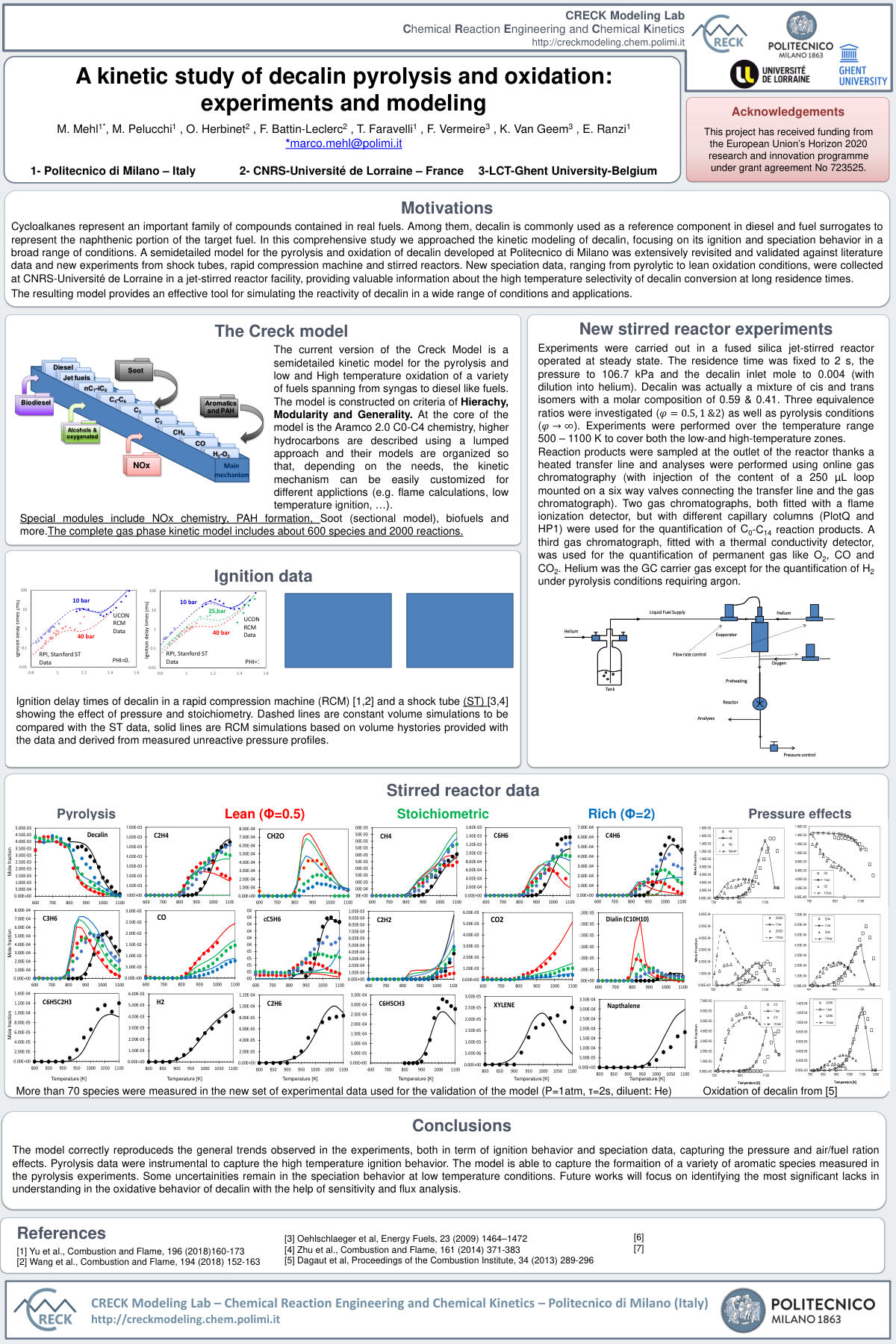
So far, only a few studies have been reported in the literature about the combustion of α- methylnaphthalene (AMN). However, AMN represents both a key precursor of soot, as a polycyclic aromatic hydrocarbon (PAH) with an aliphatic side chain, and an important component of fuel surrogates (e.g. diesel and jet fuels). In this work we present new experimental data and a revised kinetic model, validated over a wide range of operating conditions. Laminar flame speed have been measured in a spherical combustion vessel [1] at atmospheric pressure and unburned gas temperatures of 425 K, 445 K and 484 K. Ignition delay times have been measured in a shock tube facility [2] at T=1000-1300 K and p=10 bar, for lean mixtures (φ=0.50, 0.65 and 0.80) of n-heptane and AMN. The main chemical pathways of AMN are revised and implemented in the gas-phase CRECK kinetic model. With the aim of developing a systematic model based on rate rules and analogy between monoaromatic hydrocarbon (MAH) and PAH, the reactivity of α-methylnaphthalene is mainly tailored to that of toluene and other single ring aromatic hydrocarbons for which we recently performed systematic theoretical investigations [3-9]. The model is then validated by comparison with the new experimental data and all of the other targets available in the literature for pure AMN and its mixtures with n-decane. The model generally well captures the experimental data. Sensitivity analyses are performed to assess possible key reactions and reaction classes that must be further investigated to improve the kinetic mechanism at conditions where the model predictions deviates significantly from the experimental measurements.
Conference Information
37th INTERNATIONAL SYMPOSIUM ON COMBUSTION
Identifiers
Funding Information
Authors
Marco Mehl
Politecnico di Milano
Matteo Pelucchi
Politecnico di Milano
Olivier Herbinet
CNRS-Université de Lorraine
Frédérique Battin-Leclerc
CNRS-Université de Lorraine
Tiziano Faravelli
Politecnico di Milano
F. Vermeire
LCT-Ghent University
Kevin Van Geem
LCT-Ghent University
Eliseo Ranzi
Politecnico di Milano