Description
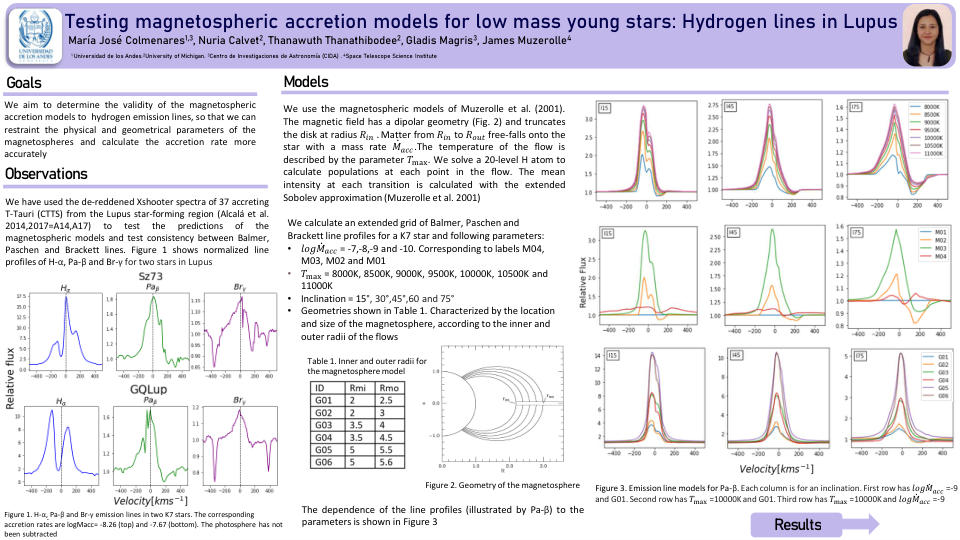
The study of emission lines formed in the magnetospheric accretion flows around young stars allows us to constrain the thermal and geometrical properties of the flows, which can later help us to determine accretion rates more accurately. Our main goal is to prove the validity of the magnetospheric accretion models ( Muzerolle et al. 2001) by comparing theoretical fluxes with those calculated from observations. We use the de-reddened fluxes data from Alcalá et al.(2014,2017) of 37 stars from the Lupus region, ranging from K5 to M4, as well as the accretion rates calculated in that paper. We study Halpha, BrGamma and PaBeta, from which we conclude that for higher accretion rates the magnetosphere is cold, wide and close to the star and for lower accretion rates the flows are further away from the star, narrow and have higher temperatures; this can be seen throughout the three lines studied.
Conference Information
Lupus
Identifiers
Authors
Maria Jose Colmenares
University of the Andes
Nuria Calvet
University of Michigan
Thanawuth Thanathibodee
University of Michigan
Gladis Magris
Centro de Investigaciones de Astronomia (CIDA)
James Muzerolle
Space Telescope Science Institute