Description
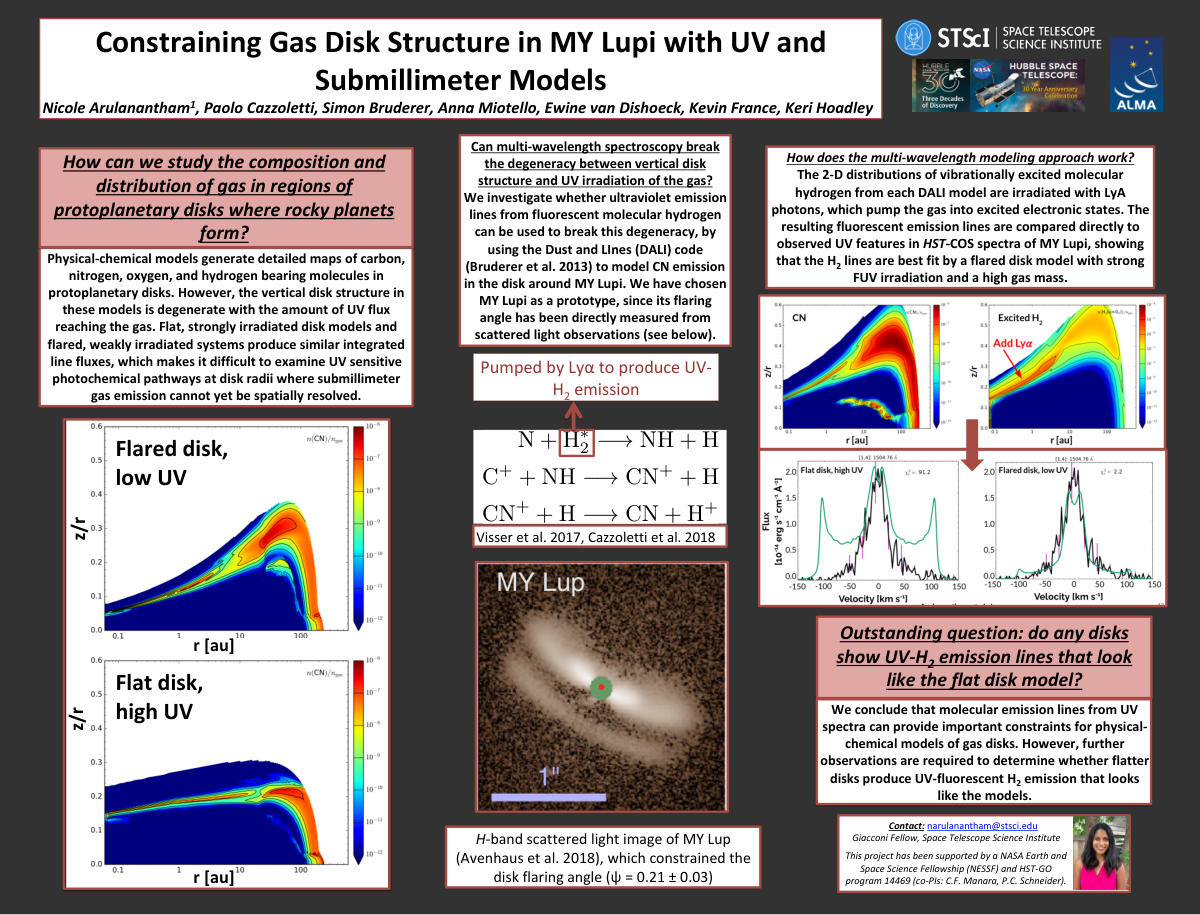
Physical-chemical models generate detailed maps of carbon, nitrogen, oxygen, and hydrogen bearing molecules in protoplanetary disks. However, the vertical disk structure in these models is degenerate with the amount of UV flux reaching the gas. Flat, strongly irradiated disk models and flared, weakly irradiated systems produce similar molecular gas distributions, which makes it difficult to examine UV sensitive photochemical pathways in systems from which submillimeter gas emission has not been spatially resolved. We investigate whether ultraviolet emission lines from fluorescent molecular hydrogen can be used to break this degeneracy, by using the Dust and LInes (DALI) code to generate a grid of physical-chemical models based on the disk around MY Lupi. The 2-D distributions of vibrationally excited molecular hydrogen from each DALI model are then irradiated with LyA photons, which pump the gas into excited electronic states. The resulting fluorescent emission lines are compared directly to observed UV features in HST-COS spectra of MY Lupi, showing that the H2 lines are best fit by a flared disk model with strong FUV irradiation and a high gas mass. We conclude that emission lines from UV spectra can provide important constraints for physical-chemical models of gas disks.
Identifiers
Authors
Nicole Arulanantham
Space Telescope Science Institute
Paolo Cazzoletti
Simon Bruderer
Anna Miotello
Ewine van Dishoeck
Kevin France
Keri Hoadley