Description
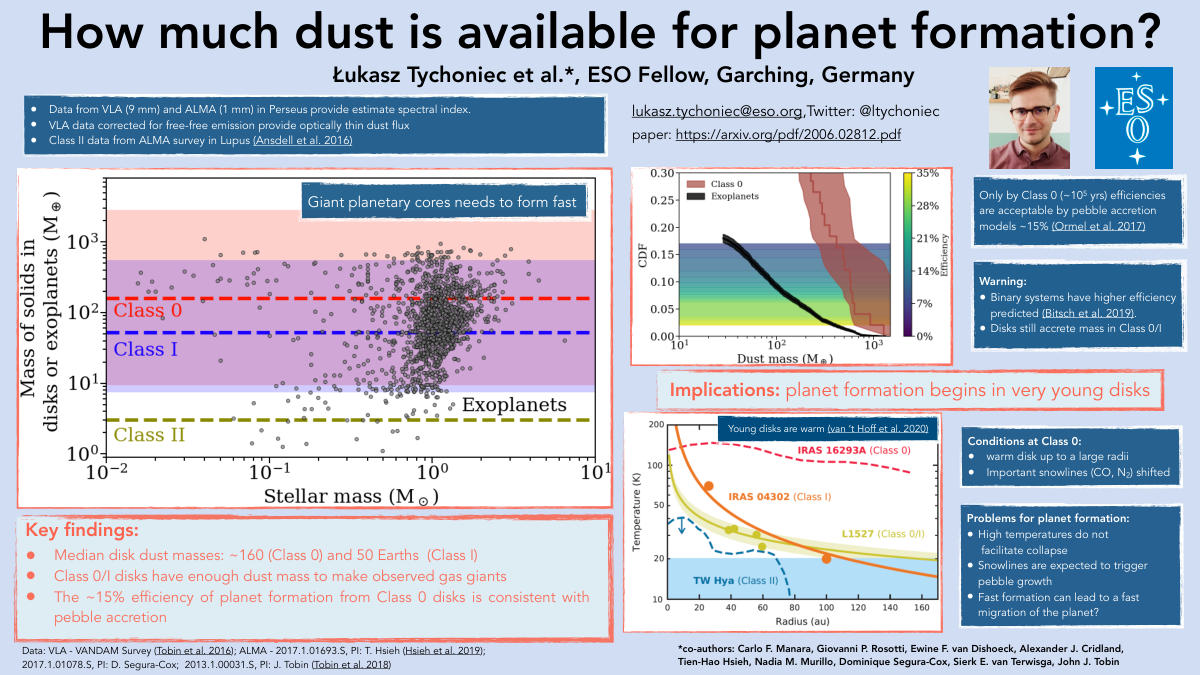
In recent years evidence has been building that planet formation starts early, in the first 0.5 Myr. Therefore the physical conditions at the early stages of star formation are crucial to understanding the origin of the planetary systems. We use Atacama Large Millimeter/submillimeter Array (ALMA) observations of embedded disks in Perseus together with existing Very Large Array (VLA) data to provide a robust estimate of disk masses and to compare the Perseus survey of dust masses with other ALMA surveys of young and mature disks. We put the disk mass estimates in the context of known exoplanetary systems. The dust masses of disks in Class 0/I are significantly larger than those inferred for Class II disks in other regions. The masses of Class 0 and I disks in Perseus can produce the observed exoplanet systems with efficiencies acceptable by planet formation models. The most massive observed exoplanets can still be produced by the most massive Class 0 disks with an efficiency of 15%, higher efficiencies are needed if the planet formation starts in Class I. Constraining the starting point of the planet formation and the mass reservoir available is crucial for modern models of the planet formation.
Conference Information
ESO
Identifiers
Authors
Lukasz Tychoniec
ESO - Garching
Łukasz Tychoniec
ESO Fellow, Garching, Germany
Carlo F. Manara
Giovanni P. Rosotti
Ewine F. van Dishoeck
Alexander J. Cridland
Tien-Hao Hsieh
Nadia M. Murillo
Dominique Segura-Cox
Sierk E. van Terwisga
John J. Tobin