Description
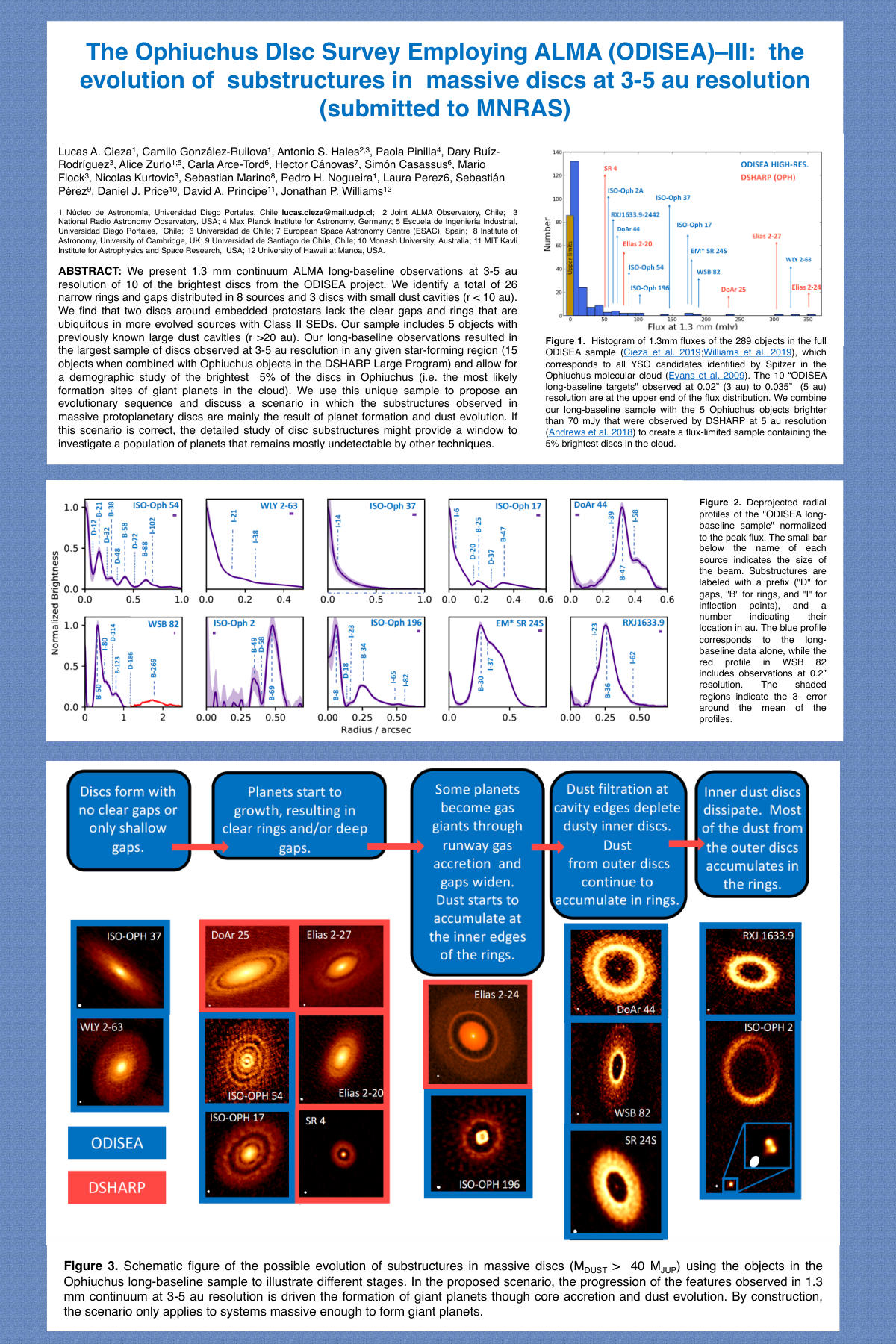
We present 1.3 mm continuum ALMA long-baseline observations at 3-5 au resolution of 10 of the brightest discs from the ODISEA project. We identify a total of 26 narrow rings and gaps distributed in 8 sources and 3 discs with small dust cavities (r < 10 au). We find that two discs around embedded protostars lack the clear gaps and rings that are ubiquitous in more evolved sources with Class II SEDs. Our sample includes 5 objects with previously known large dust cavities (r >20 au). Our long-baseline observations resulted in the largest sample of discs observed at 3-5 au resolution in any given star-forming region (15 objects when combined with Ophiuchus objects in the DSHARP Large Program) and allow for a demographic study of the brightest 5% of the discs in Ophiuchus (i.e. the most likely formation sites of giant planets in the cloud). We use this unique sample to propose an evolutionary sequence and discuss a scenario in which the substructures observed in massive protoplanetary discs are mainly the result of planet formation and dust evolution. If this scenario is correct, the detailed study of disc substructures might provide a window to investigate a population of planets that remains mostly undetectable by other techniques. These results are presented in https://arxiv.org/abs/2012.00189.
Conference Information
MNRAS
Identifiers
Authors
Lucas A. Cieza
Institute of Astronomy, University of Cambridge