Description
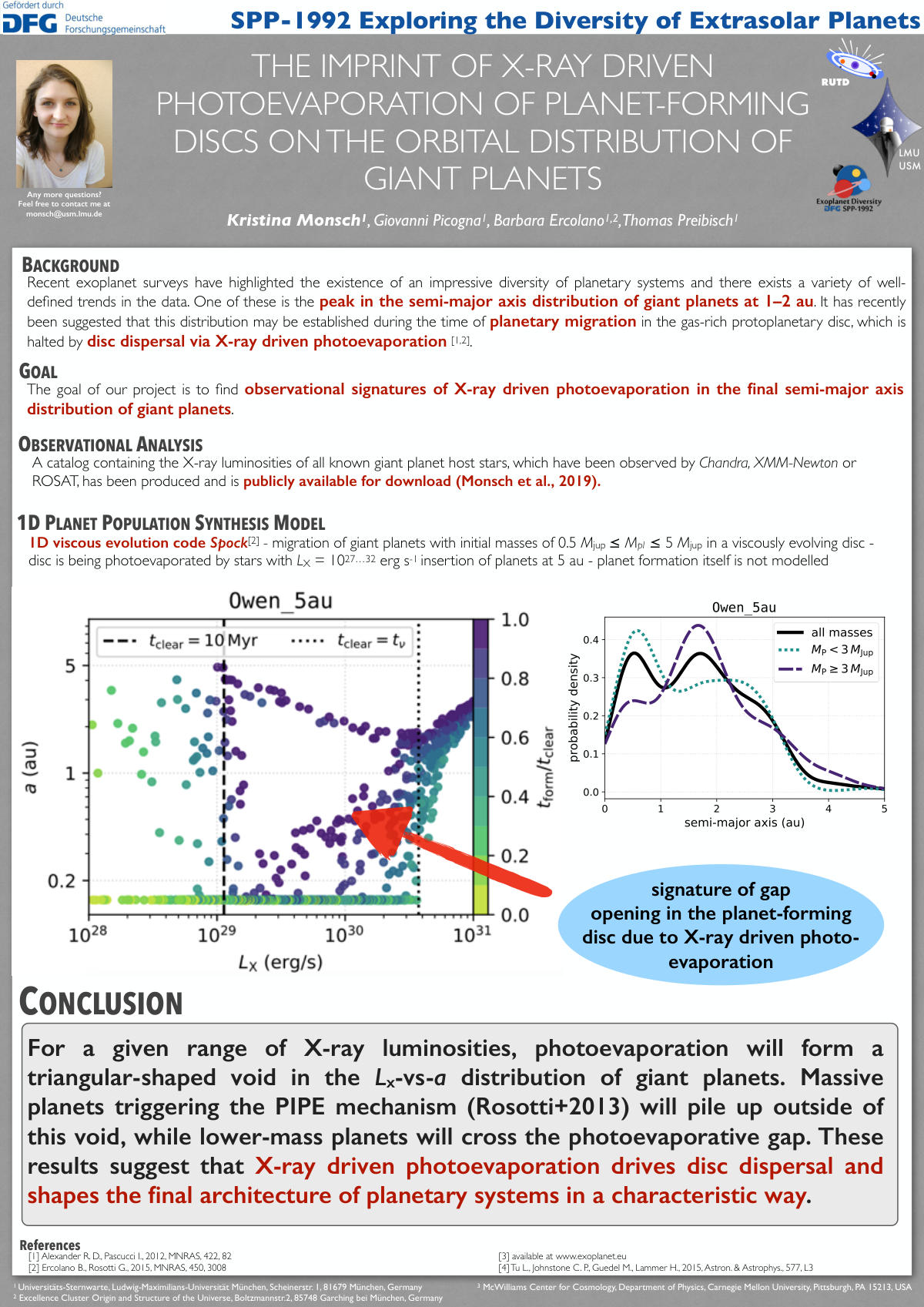
Recent exoplanet surveys have highlighted the existence of an impressive diversity of planetary systems, raising the question of how systems similar to our own can form and develop. The key to explaining the diversity of planetary systems is in the understanding of the statistical trends that are emerging from the recent wealth of exoplanet data. One of these is the non-uniform distribution of the semi-major axes of gas giants. Giant planets are found to preferentially clump up at orbital radii of ~1-2 au and finding what determines this peak is of strong interest. It has recently been suggested that this distribution may be established during the time of planetary migration in the protoplanetary disc, being halted by X-ray driven photoevaporation (Ercolano & Rosotti, 2015). We have searched for signatures of this process by correlating the X-ray luminosity of host stars with the semi-major axis distribution of their giant planets. Our statistical analysis of the observational data confirms a prominent feature that is also predicted by simulations, further strengthening the conclusion that X-ray photoevaporation may be shaping the architecture of planetary systems.
Conference Information
SPP-1992
Identifiers
Authors
Kristina Monsch
USM/LMU, Munich
Giovanni Picogna
Ludwig-Maximilians-Universität München
Barbara Ercolano
Ludwig-Maximilians-Universität München
Thomas Preibisch
Ludwig-Maximilians-Universität München