Description
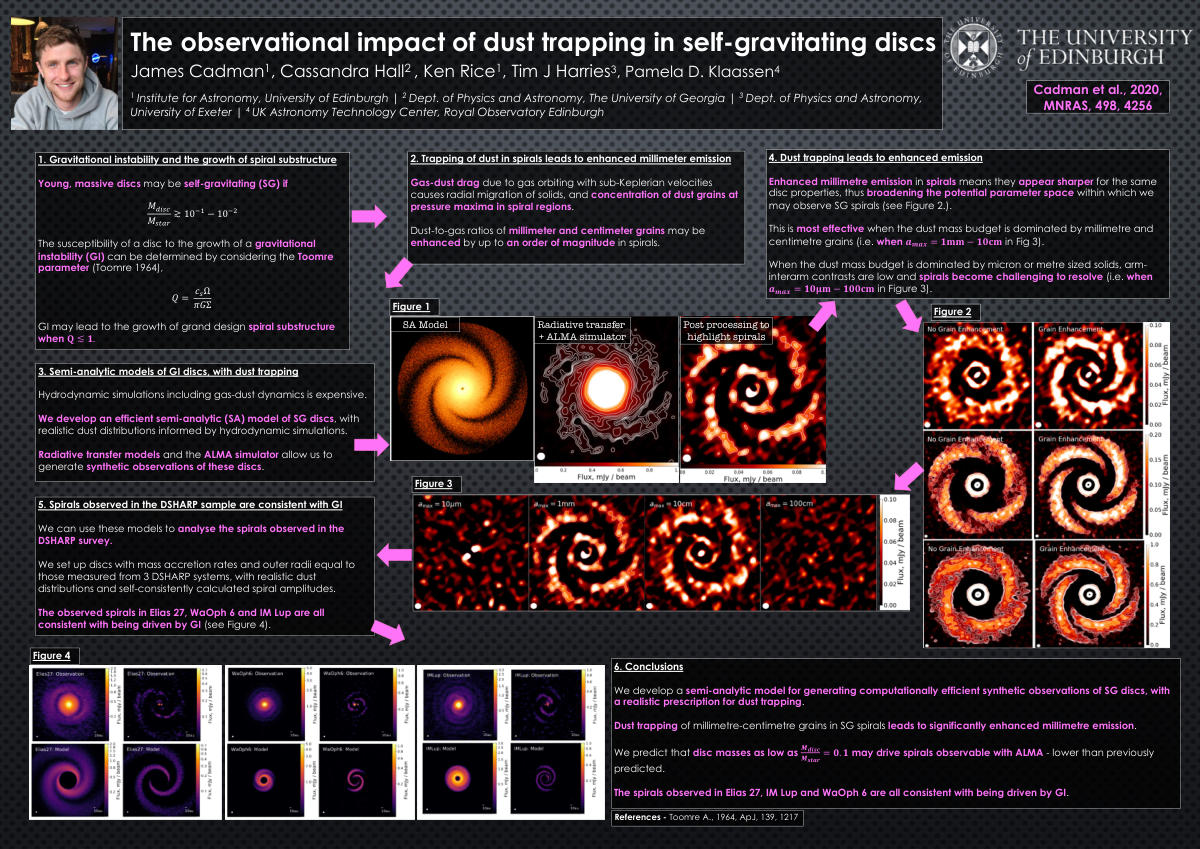
The gravitational instability (GI) may play an important role in the very early evolution of protoplanetary discs by providing a source of viscosity, generating conditions suitable for accelerated dust growth, and potentially forming giant gaseous protoplanets through the direct gravitational collapse of disc material. It is now possible to observe young discs with telescopes such as ALMA. However a self-gravitating phase is likely to be brief (t<10^5 yrs) as a disc will rapidly evolve toward a lower mass, gravitationally stable state, thus limiting our prospects of observing these systems. In this work we use Monte Carlo radiative transfer models to analyse how dust-trapping in the spiral regions of self-gravitating discs results in enhanced emission, and we place constraints on the disc properties required to drive spiral features detectable with ALMA. We also analyse the Elias 27, WaOph 6 and IM Lup disc observations from the DSHARP survey, and make predictions about the nature of the spiral substructure which has been observed.
Conference Information
DSHARP
Identifiers
Authors
James Cadman
University of Edinburgh