Description
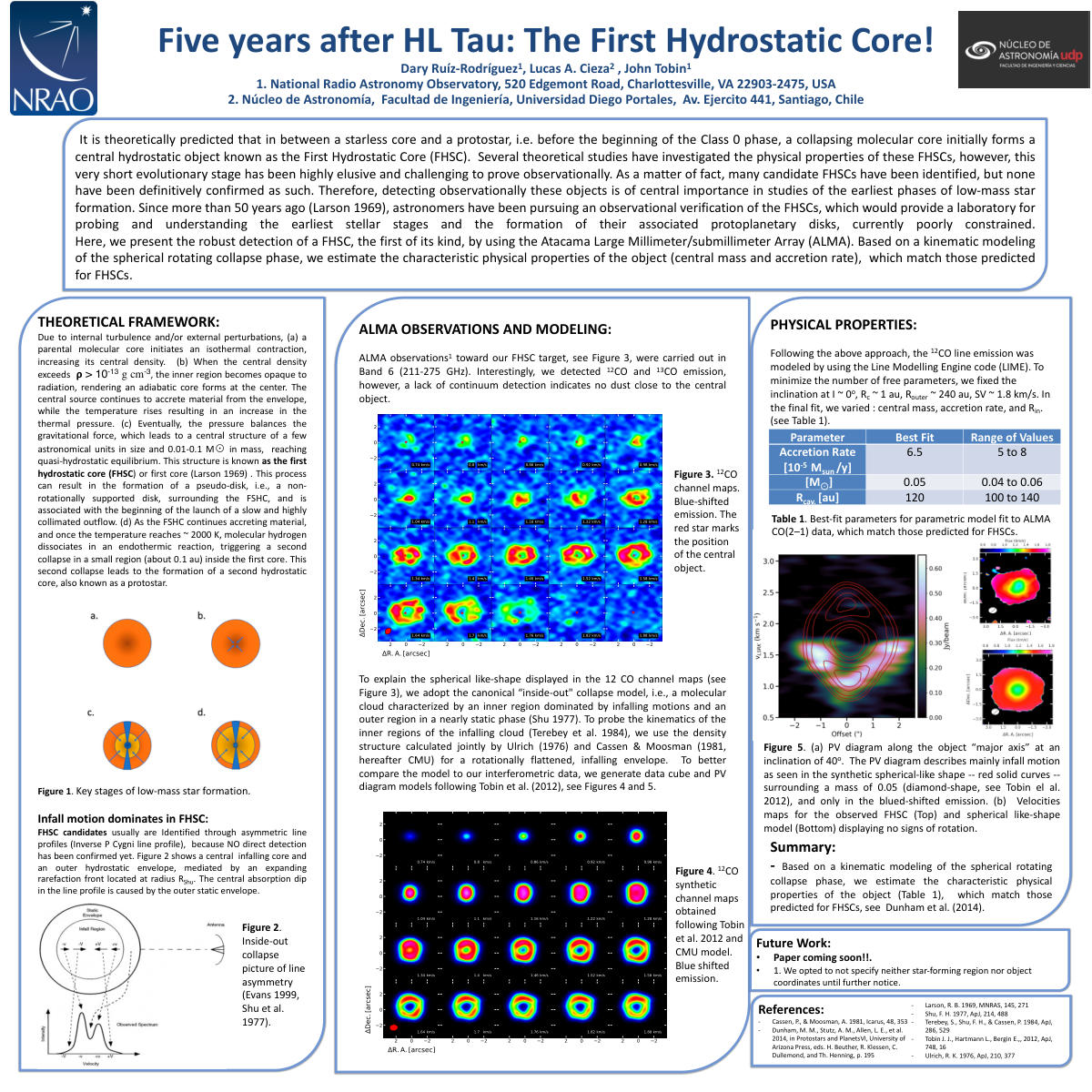
It is theoretically predicted that in between a starless core and a protostar, i.e. before the beginning of the Class 0 phase, a collapsing molecular core initially forms a central hydrostatic object known as the First Hydrostatic Core (FHSC). Several theoretical studies have investigated the physical properties of these FHSCs, however, this very short evolutionary stage has been highly elusive and challenging to prove observationally. As a matter of fact, many candidate FHSCs have been identified, but none have been definitively confirmed as such. Therefore, detecting observationally these objects is of central importance in studies of the earliest phases of low-mass star formation. Since more than 50 years ago (Larson 1969), astronomers have been pursuing an observational verification of the FHSCs, which would provide a laboratory for probing and understanding the earliest stellar stages and the formation of their associated protoplanetary disks, currently poorly constrained. Here, we present the robust detection of a FHSC, the first of its kind, by using the Atacama Large Millimeter/submillimeter Array (ALMA). Based on a kinematic modeling of the spherical rotating collapse phase, we estimate the characteristic physical properties of the object (central mass and accretion rate), which match those predicted for FHSCs.
Identifiers
Authors
Dary Ruiz-Rodriguez
National Radio Astronomy Observatory
Lucas A. Cieza
John Tobin