Description
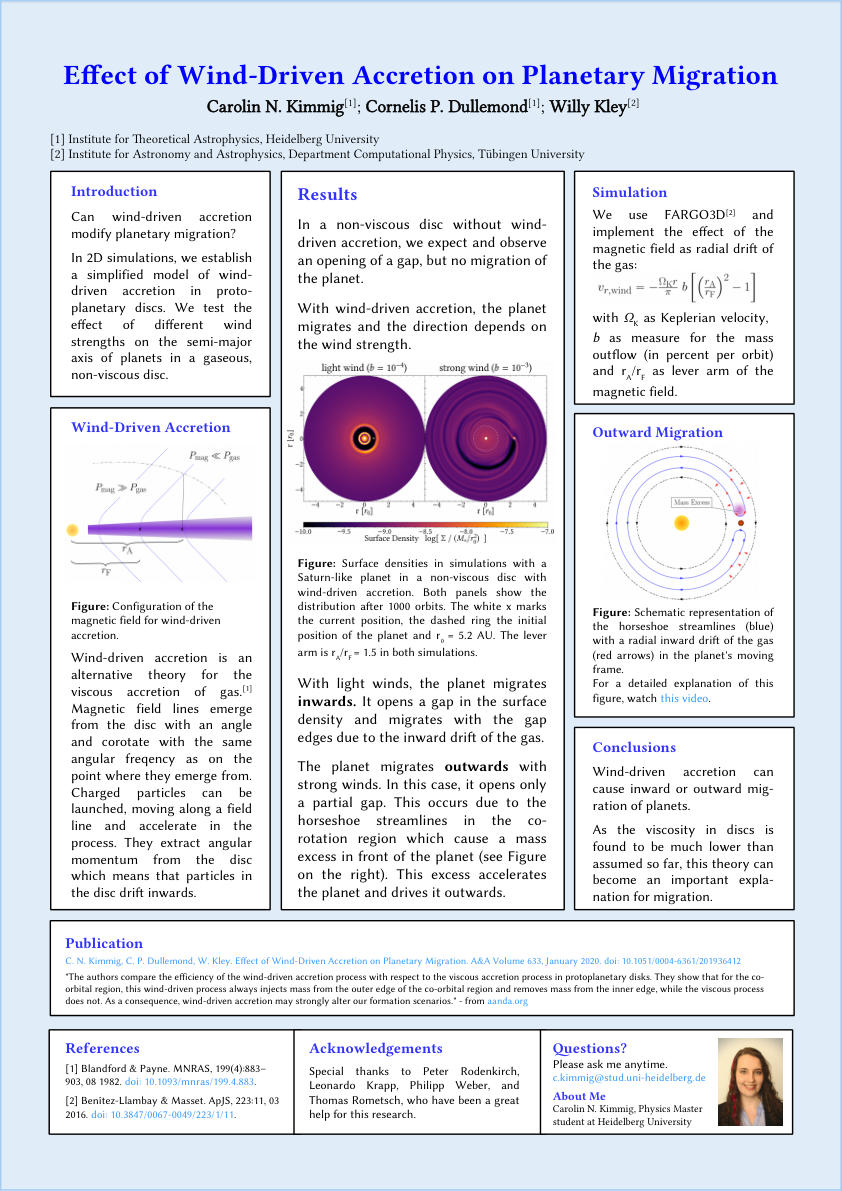
Can wind-driven accretion modify planetary migration? Planetary migration plays an important role in planet formation models and statistics of observed exoplanets. So far, the theory of planetary migration has focused on the interaction of one or more planets with an inviscid or viscously evolving gaseous disk. Wind-driven accretion, however, additionally influences the gas evolution in a protoplanetary disk and might therefore have an impact on the orbital parameters of a planet within the disk In 2D hydrodynamic simulations, we establish a simplified model of wind-driven accretion in protoplanetary disks treating the wind not explicitly but as a torque on the gas caused by the wind.With this simplified model we investigate the main effects with different wind strengths in a qualitative way rather than quantitatively predicting the outcome. We find that for the co-orbital region, this wind-driven process always injects mass from the outer edge of the co-orbital region and removes mass from the inner edge, in contrast to the viscous evolution, where mass is injected or removed from the co-orbital region depending on the radial density gradients in the disk. As a consequence, the migration behavior can differ strongly, and can under certain conditions drive rapid type-III-like outward migration.
Conference Information
A&A Volume 633
Identifiers
Authors
Carolin N. Kimmig
Institute for Theoretical Astrophysics, Heidelberg University
Cornelis P. Dullemond
Institute for Astronomy and Astrophysics, Department Computational Physics, Tubingen University
Willy Kley
Institute for Astronomy and Astrophysics, Department Computational Physics, Tubingen University