Description
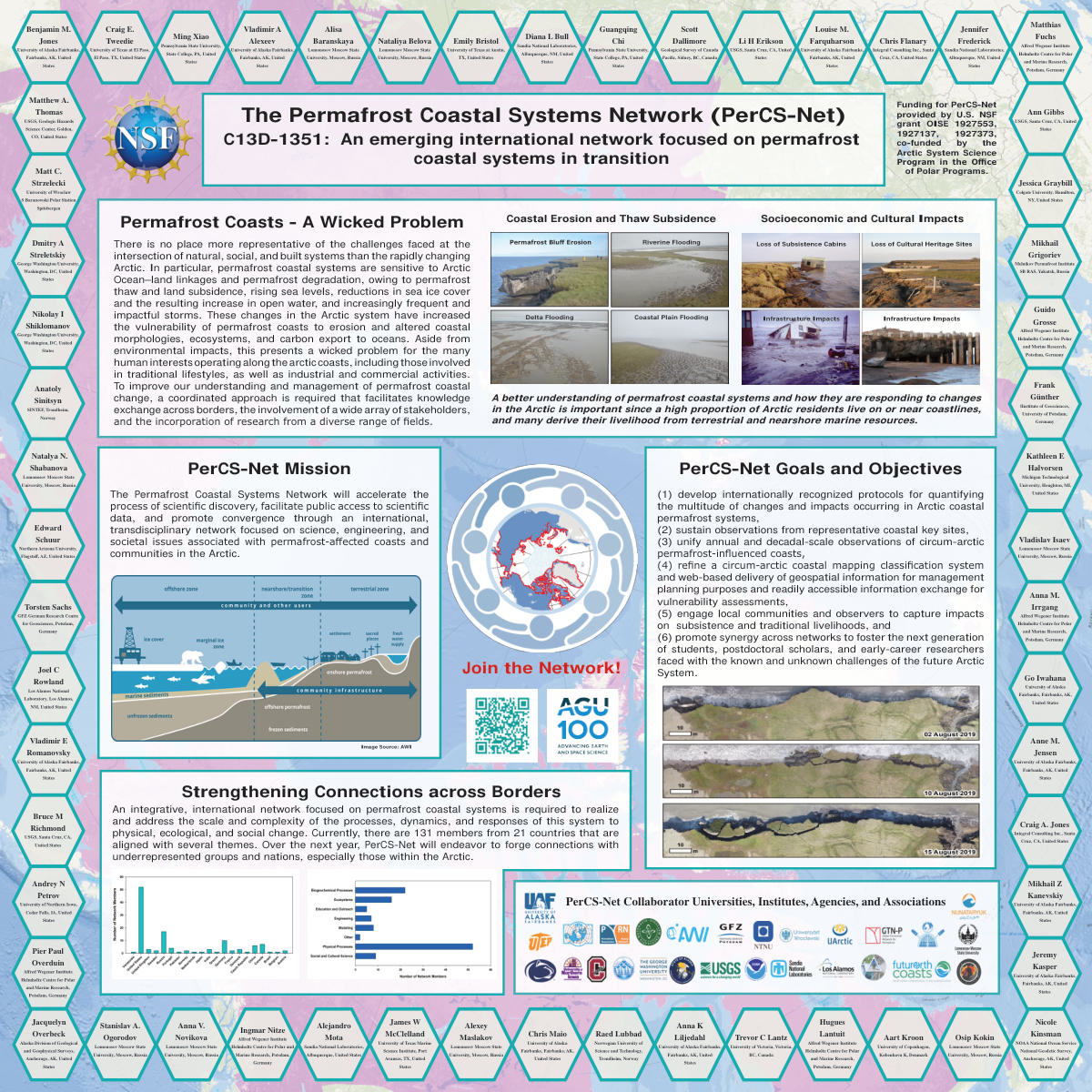
Perennially frozen ground and sea ice are key constituents of permafrost coastal systems, and their presence is the primary difference between temperate and high-latitude coastal processes. These systems are some of the most rapidly changing landscapes on Earth and, in the Arctic, are representative of the challenges being faced at the intersection between natural and anthropogenic systems. Permafrost thaw, in combination with increasing sea level and decreasing sea-ice cover, exposes arctic coastal and nearshore areas to rapid environmental and social changes. Based on decadal timescales, observations in the Arctic indicate an increase in permafrost coastal bluff erosion and storm surge flooding of low-lying ice-rich permafrost terrain. However, circum-arctic observations remain limited and the factors responsible for the apparent increase in arctic coastal dynamics are poorly constrained. A better understanding of permafrost coastal systems and how they are responding to changes in the Arctic is important since a high proportion of Arctic residents live on or near coastlines, and many derive their livelihood from terrestrial and nearshore marine resources. An expanding industrial, scientific, and commercial presence in the Arctic Ocean will also require advanced knowledge about permafrost coastlines as terrestrial access points. Since the issues involved span political, cultural, geographical, and disciplinary borders, an international network focused on permafrost coastal systems in transition is needed. An integrative network focused on permafrost coastal systems is required to realize and address the scale and complexity of the processes, dynamics, and responses of this system to physical, ecological, and social change. A primary focus of such an effort would be guided by the fact that the issues and impacts associated with permafrost coastal systems in transition are far greater than any single institution or discipline is capable of addressing alone. Future permafrost coastal system dynamics will challenge conventional wisdom as the system enters a new state impacting human decision making and adaptation planning, cultural heritage resources and ecosystems, and likely resulting in unforeseen challenges across the Arctic.
Conference Information
C13D-1351
Identifiers
Authors
Benjamin M. Jones
University of Alaska Fairbanks
Craig E. Tweedie
The University of Texas at El Paso
Ming Xiao
Pennsylvania State University
Vladimir A. Alexeev
Alisa Baranskaya
Nataliya Belova
Emily Bristol
The University of Texas at Austin
Diana L. Bull
Sandia National Laboratories
Chi Guangqing
Geological Survey of Canada Pacific
Scott Dallimore
Li H. Erikson
USGS, Santa Cruz, CA, United States
Louise M. Farquharson
Chris Flanary
Jennifer Frederick
Matthias Fuchs
Ann Gibbs
Colgate University
Jessica Graybill
Colgate University
Mikhail N. Grigoriev
Melnikov Permafrost Institute SB RAS
Guido Grosse
Institute of Geosciences, University of Potsdam
Frank Günther
Institute of Geosciences, University of Potsdam
Kathleen E. Halvorsen
Michigan Technological University
Vladimir Isaev
Anna M. Irrgang
Go Iwahana
Anne M. Jensen
Craig Alexander Jones
Mikhail Z. Kanevskiy
NOAA National Ocean Service National Geodetic Survey
Jeremy Kasper
NOAA National Ocean Service National Geodetic Survey
Nicole Kinsman
NOAA National Ocean Service National Geodetic Survey
Osip Kokin
Aart Kroon
University of Copenhagen
Hugues Lantuit
Trevor C Lantz
University of Victoria
Anna K. Liljedahl
Raed Lubbad
Norwegian University of Science and Technology
Christopher Maio
Alexey Maslakov
James W McClelland
University of Texas Marine Science Institute
Alejandro Mota
Albuquerque, United States
Ingmar Nitze
Helmholtz Centre for Polar and Marine Research
Anna V. Novikova
Stanislav A. Ogorodov
Jacquelyn Overbeck
Alaska Division of Geological and Geophysical Surveys
Pier Paul Overduin
Alfred Wegener Institute Helmholtz Centre for Polar and Marine Research
Andrey N. Petrov
University of Northern Iowa
Bruce M. Richmond
USGS, Santa Cruz, CA, United States
Vladimir E. Romanovsky
USGS, Santa Cruz, CA, United States
Joel C. Rowland
Los Alamos National Laboratory
Torsten Sachs
GFZ German Research Centre for Geosciences
Edward. A. G. Schuur
Northern Arizona University
Natalya N. Shabanova
Lomonosov Moscow State University
Anatoly Sinitsyn
Nikolay I. Shiklomanov
SINTEF
Dmitry A. Streletskiy
George Washington University
Matt C. Strzelecki
University of Wrocław
David Swanson
Matthew A. Thomas
Geologic Hazards Science Center
Chris Maio
University of Alaska Fairbanks
Vladislav Isaev