Description
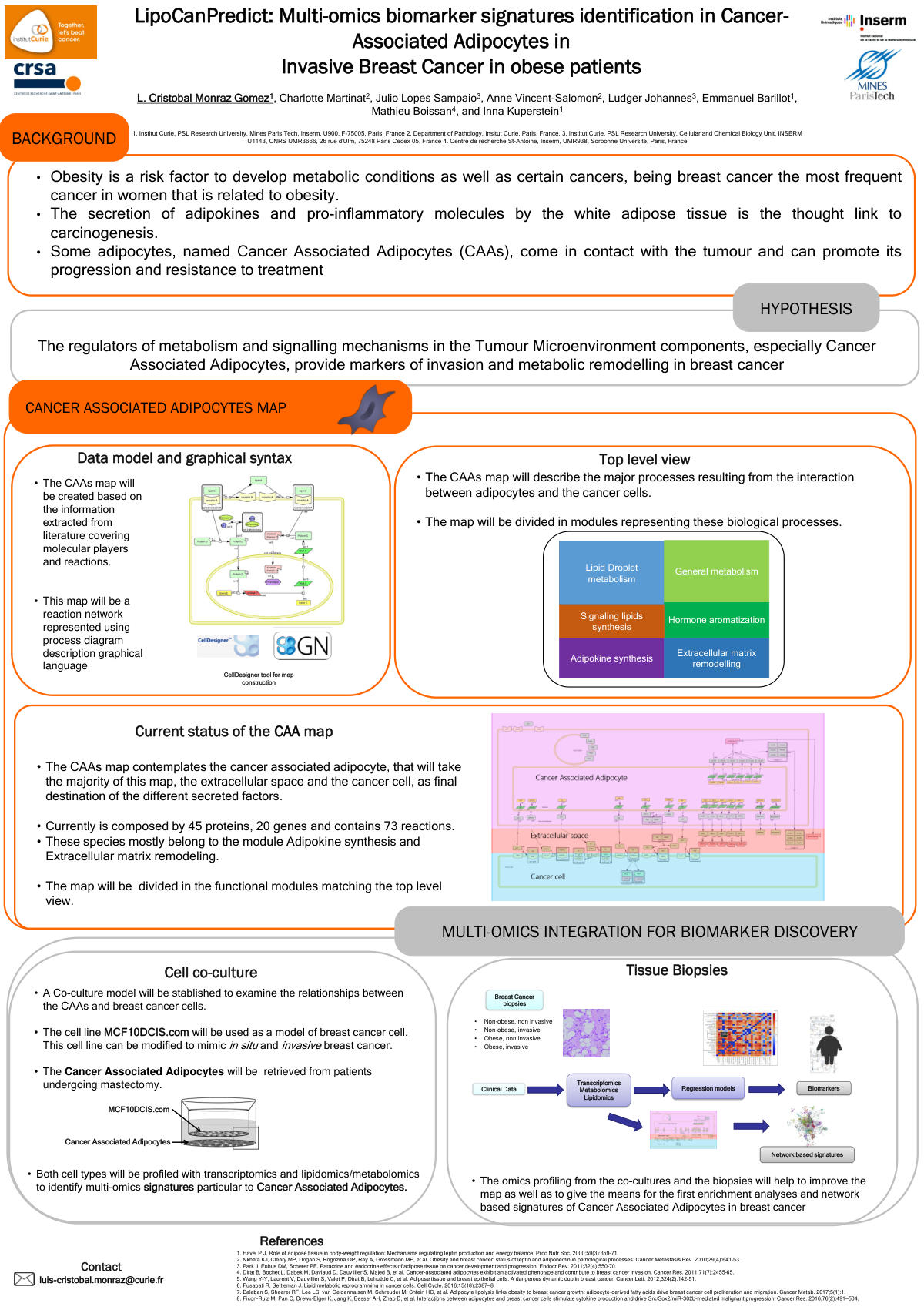
Obesity has been related to breast cancer development and progression. The secretion of adipokines and pro-inflammatory molecules by the white adipose tissue is the thought link to carcinogenesis. Some adipocytes, named Cancer Associated Adipocytes (CAAs), come in contact with the tumour and can promote its progression and resistance to treatment. Thus, CAAs are an attractive research target for the identification of signatures and biomarkers. This project will have a comprehensive analysis of multi-omics data, focused on lipidomics, of CAAs and tumour cells in breast cancer. An established model of co-culture of breast cancer cells with primary adipocytes from breast cancer patients will be used to retrieve the comprehensive multi-omics characterisation of each cell type. Moreover, existing multi-omics data with profiles from patient biopsies will be integrated. To retrieve cell type-specific signatures, data deconvolution techniques will be applied, to correlate the multi-omics signatures to phenotypic markers. In order to understand the mechanisms behind the multi-omics signatures, functional interpretation by enrichment analyses will be performed. For this purpose, two approaches, a data-driven approach, inferring the molecular networks from the data, and a knowledge-based approach, retrieving molecular networks from the literature and analysing the data in the context of the networks, will be used. This will lead to the generation of detailed molecular portraits. The goal is to uncover the mechanisms of the interaction between CAAs and cancer cells. Multi-omics predictive molecular signatures of the CAAs and the tumour cells in vitro and in obesity related breast cancer patients will be delivered. These complex signatures are expected to provide leads for clinical studies, therefore improving the current breast cancer diagnosis strategies.
Conference Information
LipoCanPredict
Identifiers
Authors
Luis Cristobal Cristobal Monraz Gomez
1. Institut Curie, PSL Research University, Mines Paris Tech, Inserm, U900, F-75005, Paris, France
Charlotte Martinat
Department of Pathology, Insitut Curie, Paris, France
Julio Lopes Sampaio
Institut Curie, PSL Research University, Cellular and Chemical Biology Unit, INSERM U1143, CNRS UMR3666, 26 rue d'Ulm, 75248 Paris Cedex 05, France
Anne Vincent-Salomon
Department of Pathology, Insitut Curie, Paris, France
Ludger Johannes
Institut Curie, PSL Research University, Cellular and Chemical Biology Unit, INSERM U1143, CNRS UMR3666, 26 rue d'Ulm, 75248 Paris Cedex 05, France
Emmanuel Barillot
1. Institut Curie, PSL Research University, Mines Paris Tech, Inserm, U900, F-75005, Paris, France
Mathieu Boissan
Centre de recherche St-Antoine, Inserm, UMR938, Sorbonne Universite, Paris, France
Inna Kuperstein
1. Institut Curie, PSL Research University, Mines Paris Tech, Inserm, U900, F-75005, Paris, France