Description
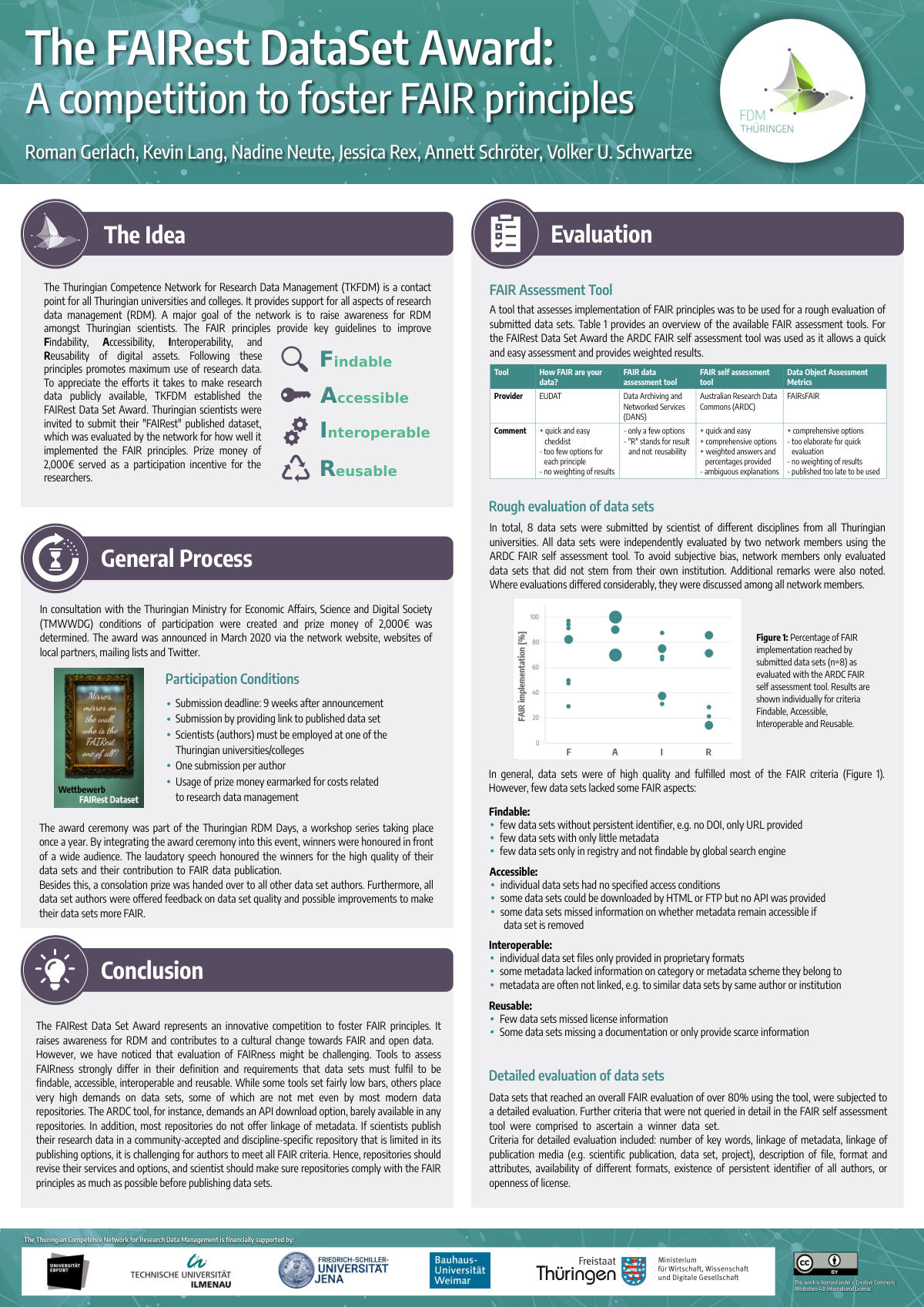
The Thuringian Competence Network for Research Data Management established the FAIRest DataSet Award to appreciate the effort it takes to make research data publicly available taking into consideration of the FAIR (findable, accessible, interoperable, reusable) principles. The concept of the competition as well as the evaluation of the submitted data sets is discussed. The award was announced in spring 2020. In consultation with the Thuringian Ministry for Economic Affairs, Science and Digital Society (TMWWDG) conditions of participation were created and prize money of 2000€, earmarked for costs related to research data management (RDM), was determined. Evaluation of submitted data sets was done in two steps: a rough evaluation based on a FAIR assessment tool and a detailed evaluation considering further criteria. The ARDC FAIR self assessment tool was selected for first evaluation as it provides comprehensive options and results given as weighted answers and in percentages. In total, eight data sets were submitted, which generally were of high quality and fulfilled most FAIR criteria. However, a few data sets lacked information especially related to interoperability and reusability as, for instance, files were only provided in proprietary formats, missed information on the metadata scheme used or applicable licences, and documentation was scarce. Detailed evaluation criteria used to determine the winning data set(s) included the number of keywords, the degree of detail of file description, format and attributes, availability of different formats as well as openness of license. The FAIRest DataSet Award is an innovative competition to foster FAIR principles. It raises awareness for RDM and contributes to a cultural change towards FAIR and open data. However, complying with FAIR criteria might be challenging. Firstly, different FAIR assessment tools strongly vary in their definition and requirements and secondly, most repositories do not offer publication options that are required (e.g. API download, linkage of metadata) to perfectly meet FAIR principles. Hence, it would be a step in the right direction for those repositories to revise their services and options. Moreover, users should make sure repositories are FAIR-compliant before publishing data sets.
Conference Information
RDA 16th Plenary
Identifiers
Authors
Roman Gerlach
Friedrich-Schiller-Universität Jena
ORCID: https://orcid.org/0000-0001-5104-4247
Kevin Lang
Bauhaus-Universität Weimar
ORCID: https://orcid.org/0000-0003-4084-514X
Nadine Neute
University of Erfurt
ORCID: https://orcid.org/0000-0002-4789-6161
Jessica Rex
Technische Universität Ilmenau
ORCID: https://orcid.org/0000-0002-9257-3812
Annett Schröter
Friedrich-Schiller-Universität Jena
ORCID: https://orcid.org/0000-0002-2542-0867
Volker Schwartze
Friedrich-Schiller-Universität Jena
ORCID: https://orcid.org/0000-0003-4429-6360