Description
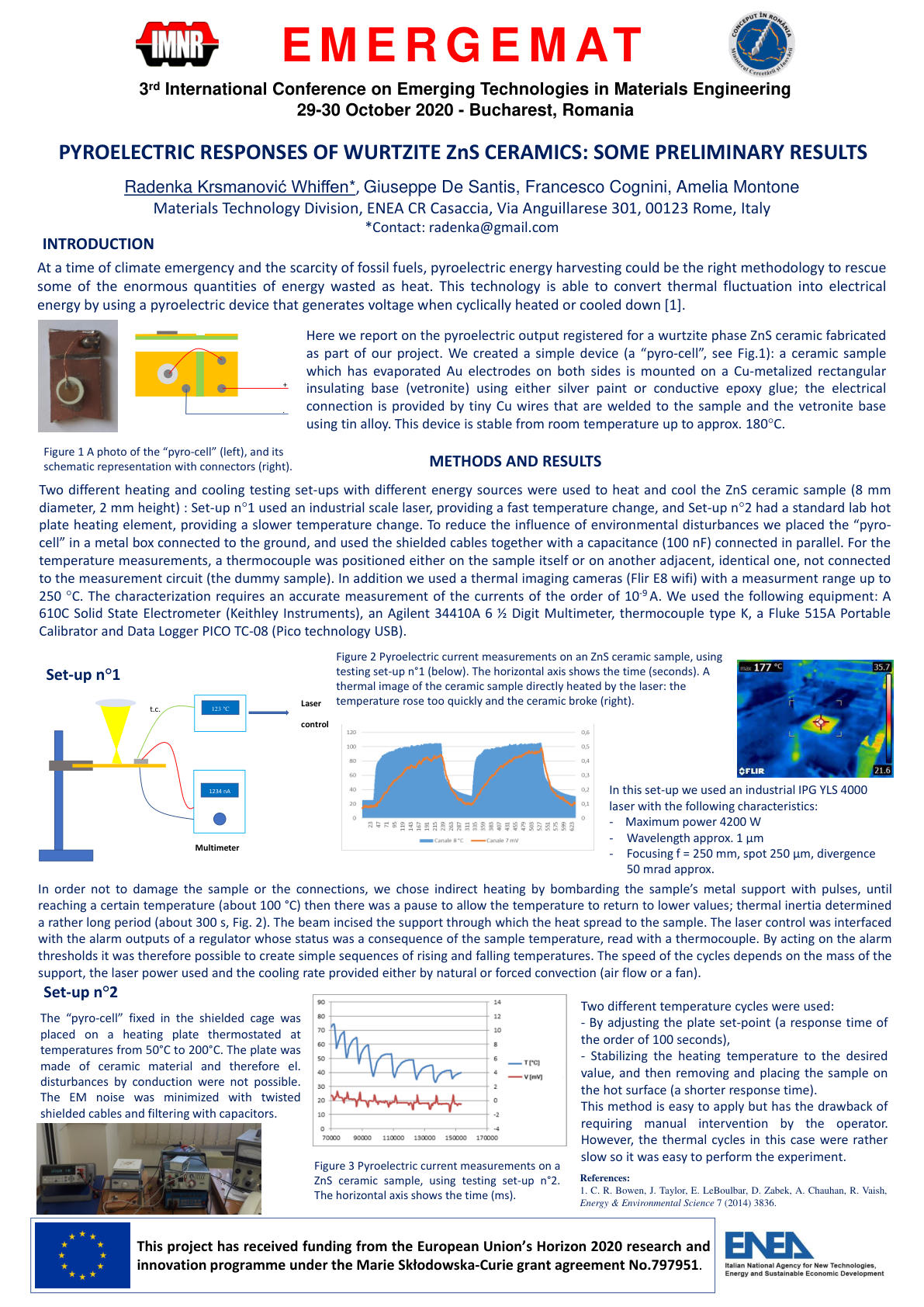
At a time of climate emergency and the scarcity of fossil fuels, pyroelectric energy harvesting could be the right methodology to rescue some of the enormous quantities of energy wasted as heat. This technology is able to convert thermal fluctuation into electrical energy by using a pyroelectric device that generates voltage when cyclically heated or cooled down [1]. Here we report on the pyroelectric output registered for a wurtzite phase ZnS ceramic. We created a simple device (a “pyro-cell”): the ceramic sample which has evaporated Au electrodes on both sides is mounted on a Cu-metalized rectangular insulating base (vetronite) using either silver paint or conductive epoxy glue; the electrical connection is provided by tiny Cu wires that are welded to the sample and the vetronite base using tin alloy. This device is stable from room temperature up to approximately 180°C. Two different heating and cooling testing set-ups were used to heat and cool the ZnS sample: Set-up n°1 used an industrial scale laser, providing a fast temperature change, and Set-up n°2 had a standard lab hot plate heating element, providing a much slower temperature change. Acknowledgements: This project has received funding from the European Union’s Horizon 2020 research and innovation programme under the Marie Skłodowska-Curie grant agreement No. 797951.
Conference Information
3rd International Conference on Emerging Technologies in Materials Engineering
Identifiers
Funding Information
European Commission
ZnS Wurtzite Nanotextured Ceramic Materials for Pyroelectric Energy Harvesting
Grant: 797951
Award detailsAuthors
Radenka Krsmanovic Whiffen
ENEA SSPT-PROMAS-MATPRO, Materials Technology Division, Casaccia Research Centre, Rome, Italy.
ORCID: https://orcid.org/0000-0001-7136-3384
Giuseppe De Santis
ENEA SSPT-PROMAS-MATPRO, Materials Technology Division, Casaccia Research Centre, Rome, Italy.
Francesco Cognini
ENEA SSPT-PROMAS-MATPRO, Materials Technology Division, Casaccia Research Centre, Rome, Italy.
Amelia Montone
ENEA SSPT-PROMAS-MATPRO, Materials Technology Division, Casaccia Research Centre, Rome, Italy.