Description
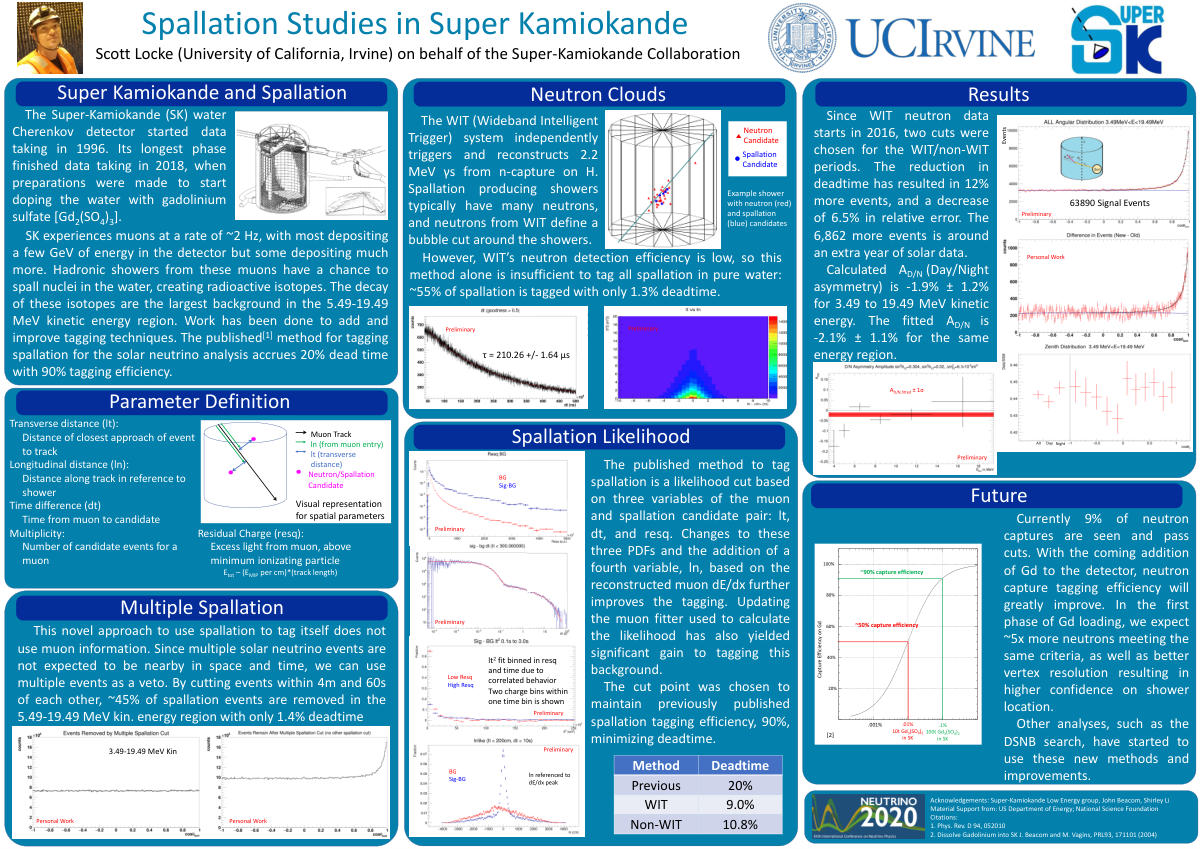
Super-Kamiokande (SK) observes about 2 muons a second at a depth of 1 km. A fraction of these muons shower, and sometimes create radioactive isotopes (spallation) which live from microseconds to seconds. This is the dominant background to neutrinos between 6 and 20 MeV, with oxygen spallation mostly caused by neutrons and pions. Detection of neutrons produced by muons serves both as an effective tag as well as an independent position measurement of spallation production. Recently, techniques utilizing these neutrons has been developed, along with improvements to former spallation tagging methods. These have reduced deadtime by ~55% (~45%) where neutron data is available (unavailable), increased signal by ~11%, and reduced relative error by ~6% for the SK-IV solar neutrino sample. SK Gadolinium phase will also improve the neutron detection efficiency and muon time correlation. These techniques may prove critical for Hyper-Kamiokande.
Conference Information
Identifiers
Authors
Scott Locke
University of California, Irvine