Description
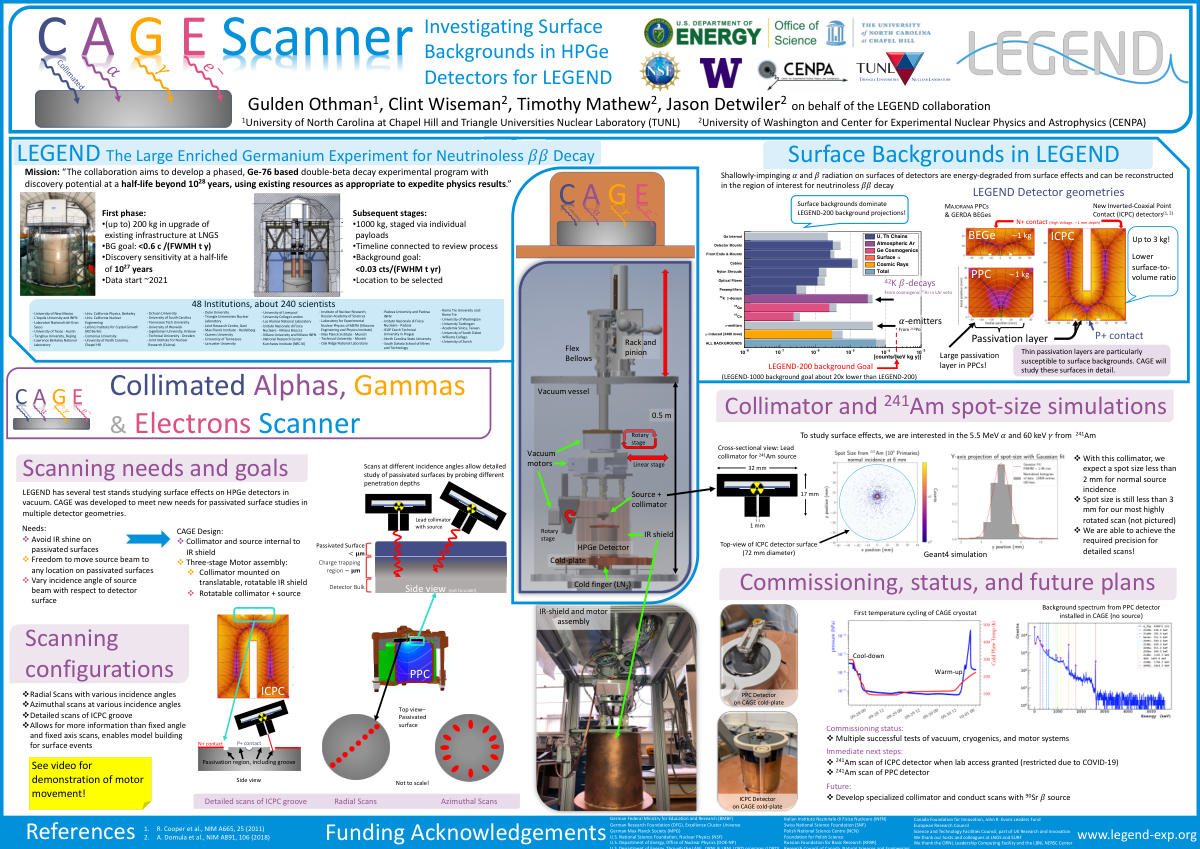
A potential source of backgrounds in a ton-scale $^{76}$Ge-based neutrinoless double-beta decay program could arise from particle interactions occurring near the surfaces of high purity germanium (HPGe) detectors. The Collimated Alphas, Gammas, and Electrons scanner (CAGE) is a test stand that allows for in-depth studies of surface events by using vacuum-side, collimated radiation sources to characterize the response of HPGe detectors to radiation at specific locations on the detector surface. LEGEND is a search for neutrinoless double-beta decay in the $^{76}$Ge isotope that will begin operation of a 200 kg array in 2021, with a plan to scale up to 1000 kg of $^{76}$Ge-enriched HPGe detectors in a phased approach. To maximize LEGEND-1000's discovery sensitivity, understanding and discriminating against backgrounds from surface events is essential. In this work we present the design, operation, and current results from CAGE.
Conference Information
Identifiers
Authors
Timothy Mathew
University of Washington and Center for Experimental Nuclear Physics and Astrophysics (CENPA)
Gulden Othman
University of North Carolina at Chapel Hill and Triangle Universities Nuclear Laboratory (TUNL)
Clint Wiseman
University of Washington and Center for Experimental Nuclear Physics and Astrophysics (CENPA)
Jason Detwiler
University of Washington and Center for Experimental Nuclear Physics and Astrophysics (CENPA)