Description
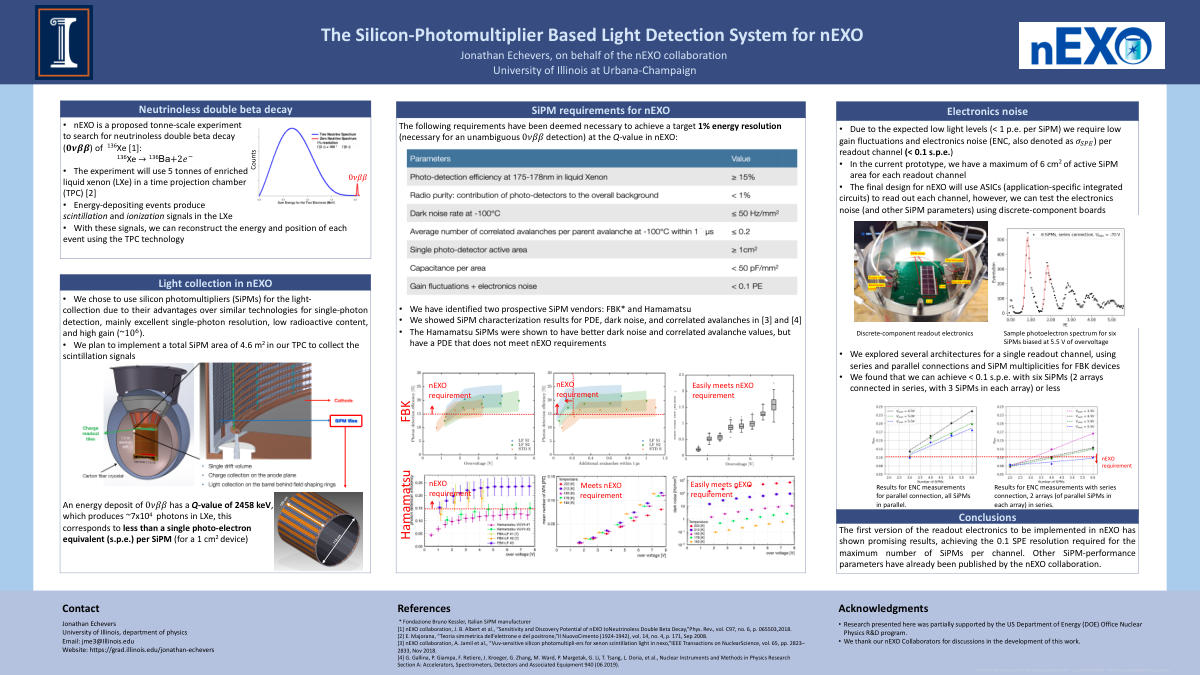
The nEXO experiment is a proposed tonne-scale liquid xenon detector to search for neutrinoless double decay ($0\nu\beta\beta$) of $^{136}$Xe, a theoretical process whose existence would have major implications for particle and nuclear physics. For an unambiguous detection of such a process, we require excellent energy resolution for events in our detector, which is directly driven by the scintillation photo-detection efficiency at 175 nm. Due to their excellent radiopurity, electronic noise, and low biasing voltage requirements, we have chosen to implement silicon photomultipliers (SiPMs) as the devices to be used for light collection in nEXO. In this presentation, I will give an overview of the baseline design for the light-readout system in nEXO, present results from a discrete-component readout channel that we tested in liquid xenon temperature, and the latest characterization results for SiPMs obtained from different vendors.
Conference Information
Identifiers
Authors
Jonathan Echevers
University of Illinois Urbana-Champaign
ORCID: https://orcid.org/0009-0001-9397-1118