Description
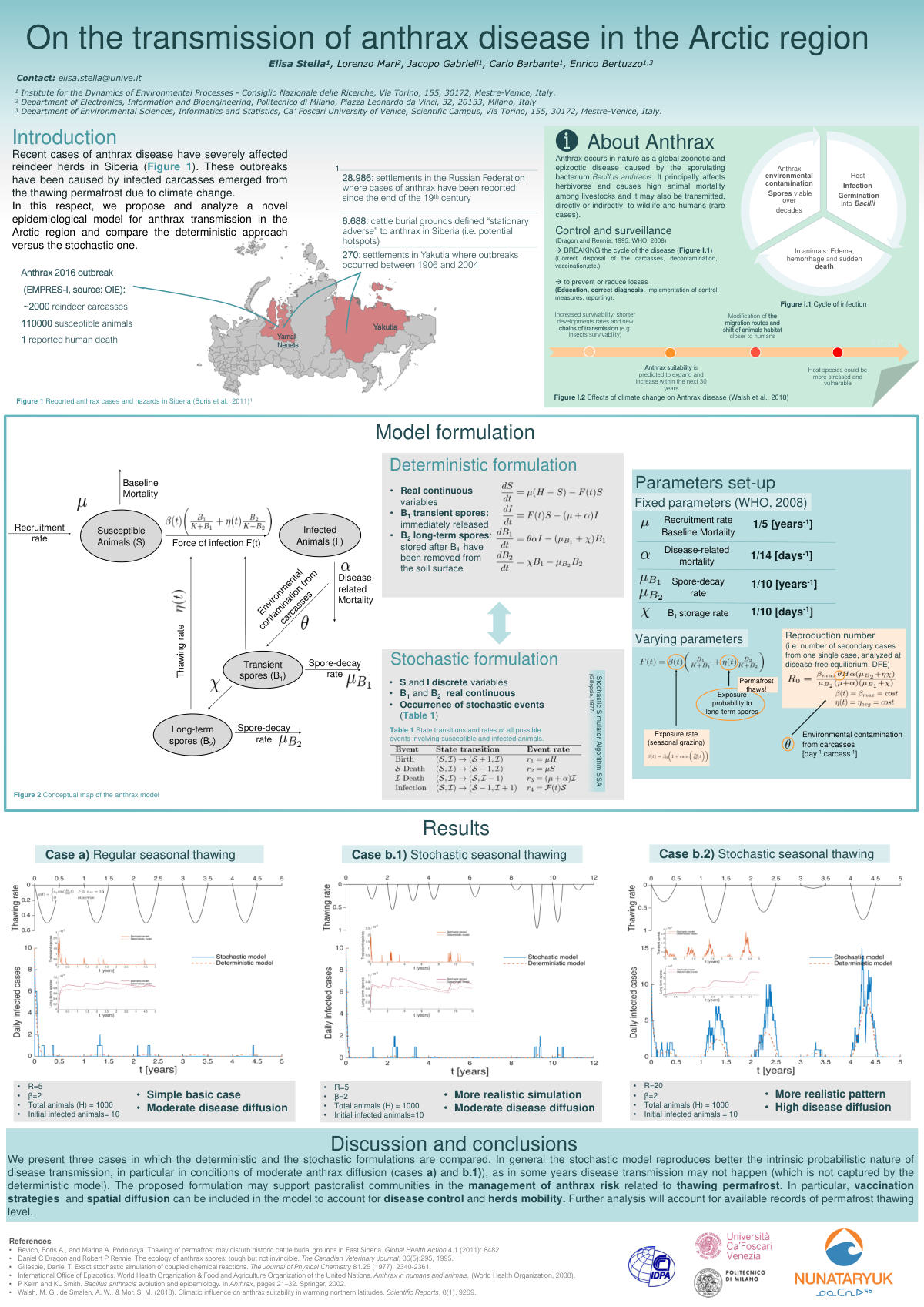
Recent cases of anthrax disease have severely affected reindeer herds in Siberia. Experts believe that these outbreaks have been caused by the presence of infected carcasses emerged from the thawing permafrost, underlying therefore the emerging character of such disease in the Arctic region due to climate change. Anthrax occurs in nature as a global zoonotic and epizootic disease caused by the sporulating bacterium Bacillus anthracis. It principally affects herbivores and causes high animal mortality. Its transmission occurs mainly via environmental contamination through spores which can remain viable in permafrost for more than 100 years. We propose and analyze a novel epidemiological model for anthrax transmission that is specifically tailored for the Arctic region. In particular, the model investigates the transmission of disease between susceptible and infected animals in the presence of environmental contamination, including also herding practices (e.g. seasonal grazing) and a seasonal environmental forcing caused by the thawing permafrost. We show how the temporal variability of these factors influences the transmission of anthrax disease and how pathogen invasion may be favored as the endemic state of the infection changes. On the basis of our results, further analyses, which may also include spatial dynamics, can establish optimal procedures to prevent uncontrolled diffusion of anthrax infection in herding areas in the Arctic.
Identifiers
Funding Information
European Commission
Permafrost thaw and the changing arctic coast: science for socio-economic adaptation
Grant: 773421
Award detailsAuthors
Elisa Stella
Institute of Polar Sciences, Consiglio Nazionale delle Ricerche, Via Torino, 155, 30172, Mestre-Venice, Italy
ORCID: https://orcid.org/0000-0002-4627-1485
Lorenzo Mari
Dipartimento di Elettronica, Informazione e Bioingegneria, Politecnico di Milano, Via Ponzio 34/5, 20133, Milan, Italy
Jacopo Gabrieli
Institute of Polar Sciences, Consiglio Nazionale delle Ricerche, Via Torino, 155, 30172, Mestre-Venice, Italy
Carlo Barbante
Institute of Polar Sciences, Consiglio Nazionale delle Ricerche, Via Torino, 155, 30172, Mestre-Venice, Italy
Enrico Bertuzzo
Department of Environmental Sciences, Informatics and Statistics, Ca' Foscari University of Venice, Scientific Campus, Via Torino, 155, 30172, Mestre-Venice, Italy