Description
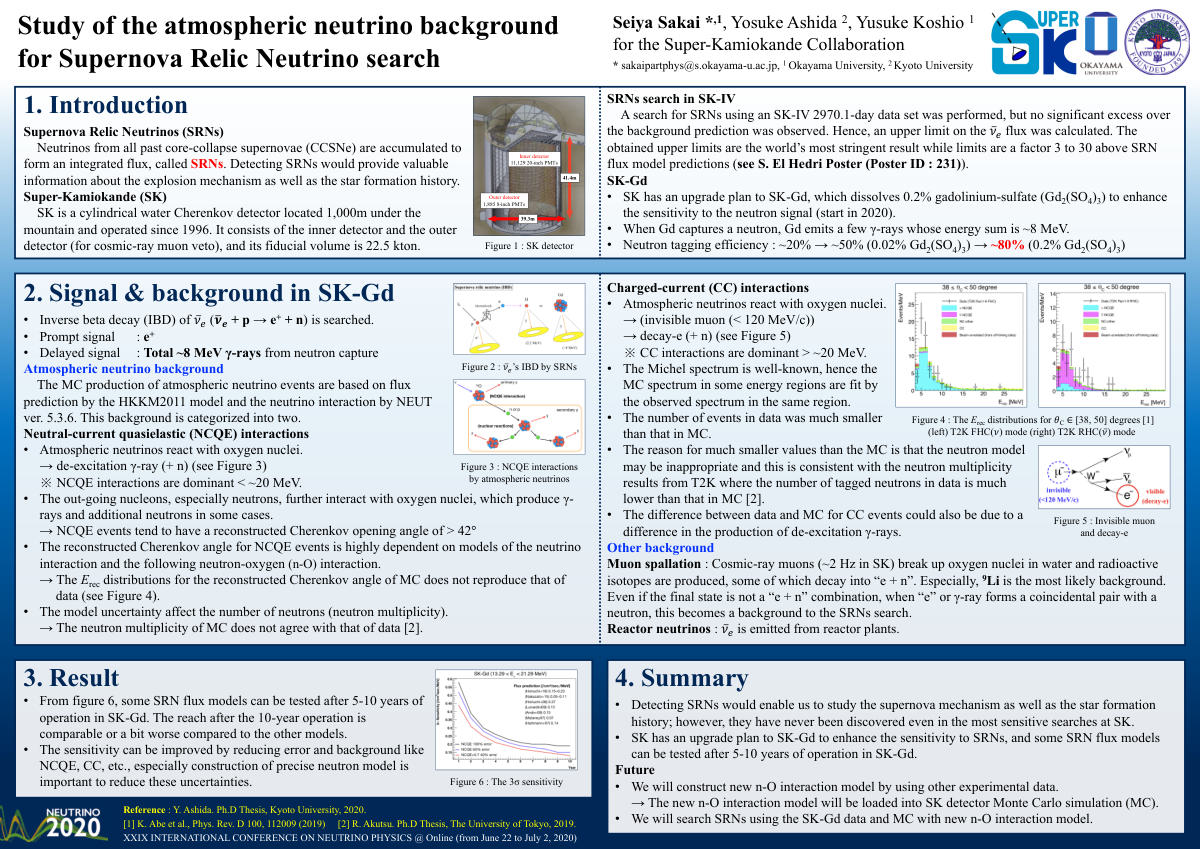
Neutrinos which were emitted from all past core-collapse supernovae form the integrated flux, called supernova relic neutrinos (SRNs). Detecting SRNs would enable us to study the supernova mechanism as well as the star formation history; however, they have never been discovered even in the most sensitive searches at Super-Kamiokande (SK). SK is a 50 kton water Cherenkov detector and has a plan to dissolve gadolinium to enhance the sensitivity to SRNs, which is termed the SK-Gd phase. In the SRN search, atmospheric neutrino interactions are one of the serious backgrounds and currently the largest uncertainty comes from de-excitation gamma-rays emitted from neutron-oxygen reactions. In this poster, I compared the number of gamma-rays emitted from neutron-oxygen reactions, neutron multiplicity and neutron energy distribution by using various neutron models installed in GEANT4-based simulation.
Conference Information
Identifiers
Authors
Seiya Sakai
Okayama University
Yosuke Ashida
Kyoto University
Yusuke Koshio
Okayama University