Description
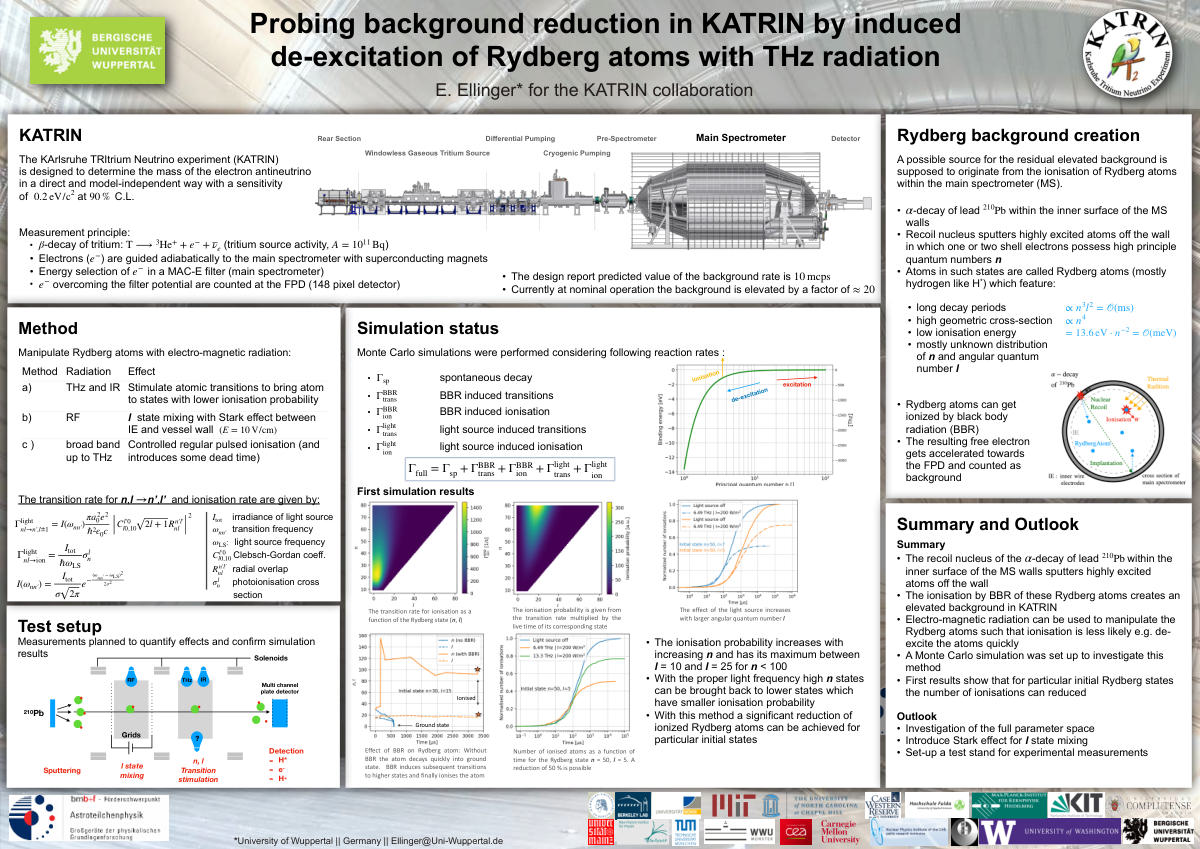
The majority of the background in the neutrino mass experiment KATRIN possibly originates from the ionization of Rydberg atoms within the main spectrometer volume. In Rydberg atoms one or more electrons have a high principal quantum number **n** resulting in a large orbital radius with long decay periods in the millisecond range. Once produced in radioactive processes in the inner surface of the spectrometer vessel, the neutral Rydberg atoms can travel through the spectrometer volume before they get ionized by thermal radiation, hence the resulting free electrons are accelerated towards the main detector, producing the background. Terahertz radiation can be used to stimulate Δ**n**= ± 1 transitions to states where spontaneous de-excitation to ground state is faster ($\mu$s-range). This approach was pioneered by the anti-hydrogen community at CERN. However, due to the different environment in comparison to atomic trap experiments, the feasibility for KATRIN must be examined.
Conference Information
Identifiers
Authors
Enrico Ellinger
University of Wuppertal