Description
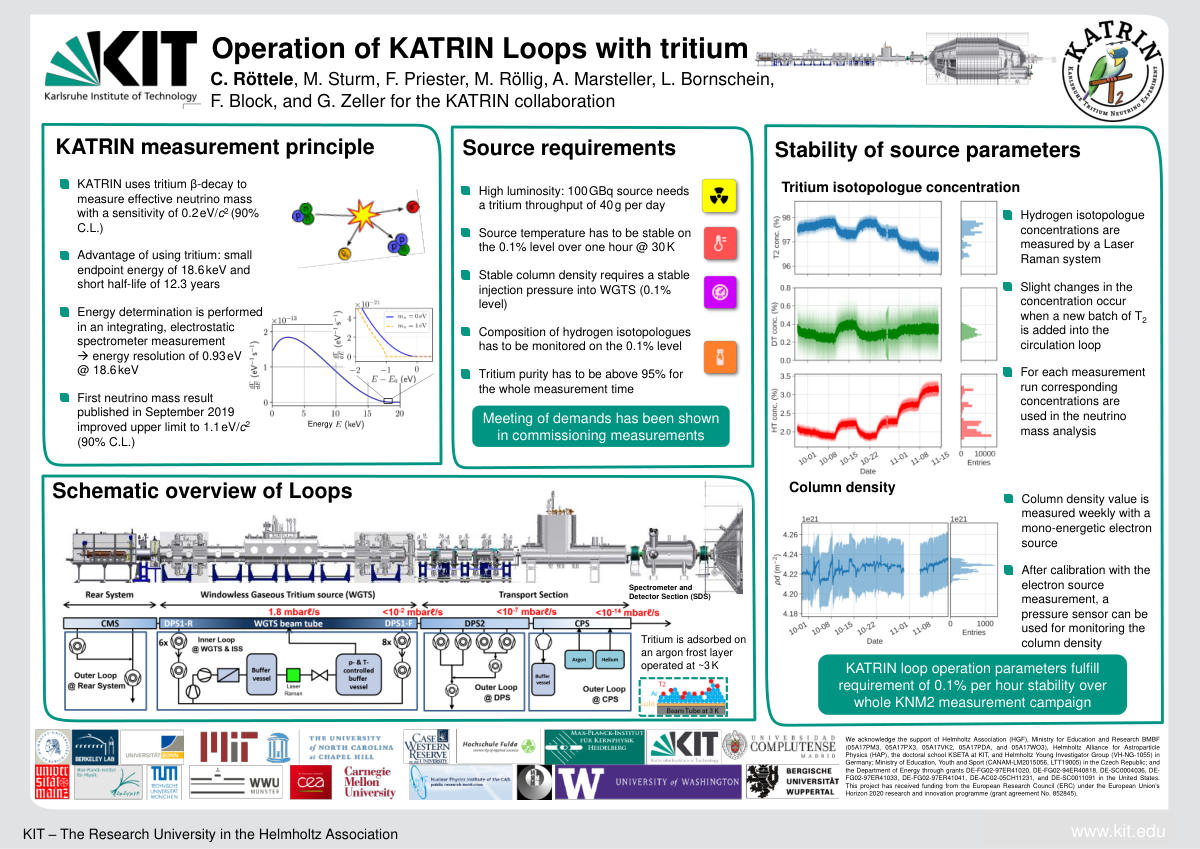
The Karlsruhe Tritium Neutrino (KATRIN) experiment aims to determine the effective neutrino mass with a sensitivity of $m_\nu=0.2$ eV/c$^2$ (90% C.L.) using electrons from the tritium beta-decay. The beta-electrons decaying in the windowless gaseous tritium source (WGTS) are guided adiabatically to the spectrometers, where their energy is analyzed with a present filter width of 2.8 eV. In order to maintain a stable column density (and therefore a stable luminosity) inside the 10 m long WGTS beam tube, a dedicated closed loop system is installed. Tritium is pumped out at both ends of the WGTS, purified and re-injected with a throughput of 1.8 mbar$\cdot$l/s into the middle of the WGTS beam tube resulting in a circulation. In this poster, the results of the first KATRIN tritium measurement campaigns are shown evaluating the stability of the Loops parameters.
Conference Information
Identifiers
Authors
Florian Priester
Carsten Rottele
Lutz Bornschein
Michael Sturm
Marco Röllig
Alexander Marsteller