Description
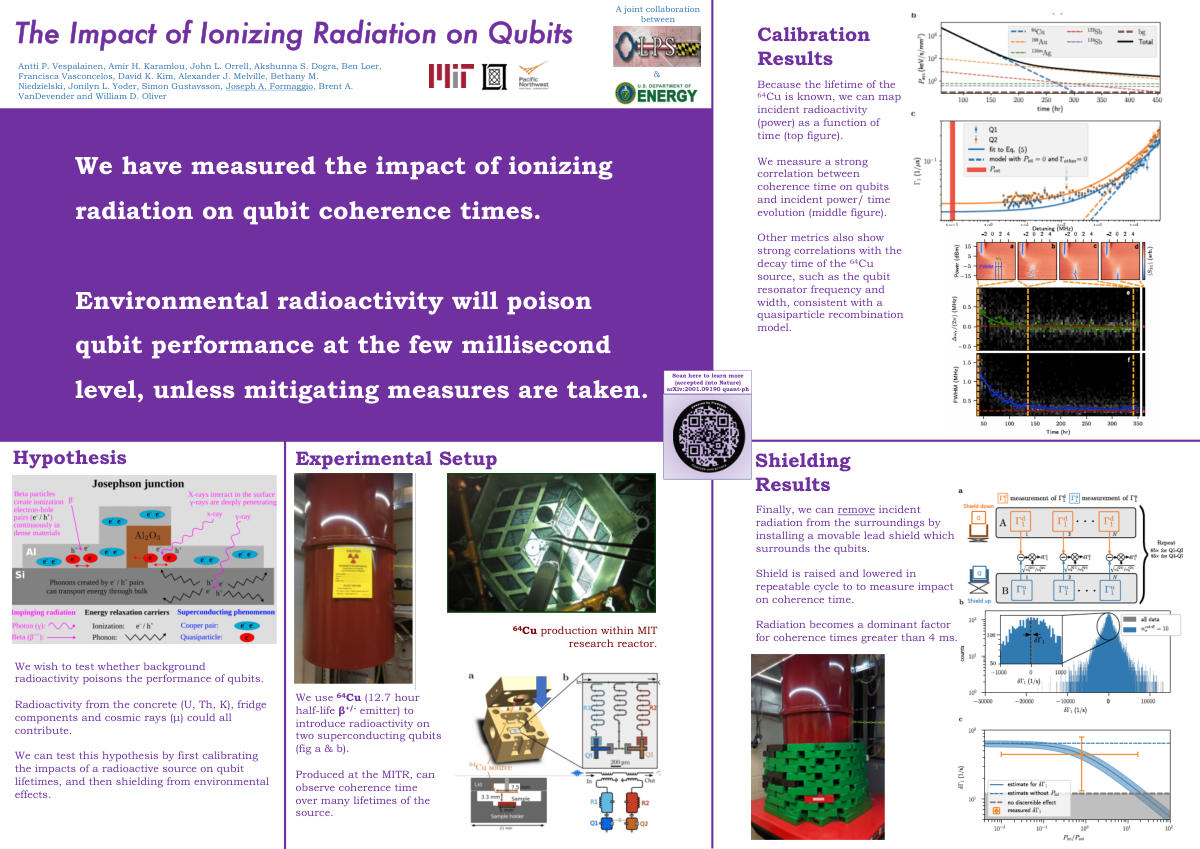
The practical viability of technologies that rely on qubits require long coherence times and high-fidelity operations. Unfortunately, the coherence of superconducting qubits is impacted by broken Cooper pairs, referred to as quasiparticles, whose experimentally observed density is orders of magnitude than their theoretically predicted values. Here we provide evidence that ionizing radiation from environmental radioactive materials and cosmic rays contributes to this observed difference. The effect of ionizing radiation leads to an elevated quasiparticle density, which we predict would ultimately limit the coherence times of superconducting qubits of the type measured here to the millisecond regime. We further demonstrate that introducing radiation shielding --a technique readily employed by many neutrino experiments-- reduces the flux of ionizing radiation and positively correlates with increased energy-relaxation time. Albeit a small effect for today's qubits, reducing or otherwise mitigating the impact of ionizing radiation will be critical for realizing fault-tolerant superconducting quantum computers.
Conference Information
Identifiers
Authors
Joseph A. Formaggio
MIT
Antti P. Vespalainen
MIT
Amir H. Karamlou
MIT
John L. Orrell
MIT
Akshunna S. Dogra
MIT
Ben Loer
MIT
Francisca Vasconcelos
MIT
David K. Kim
MIT
Alexander J. Melville
MIT
Bethany M. Niedzielski
MIT
Jonilyn L. Yoder
MIT
Simon Gustavsson
MIT
Brent A. VanDevender
MIT
William D. Oliver
MIT