Description
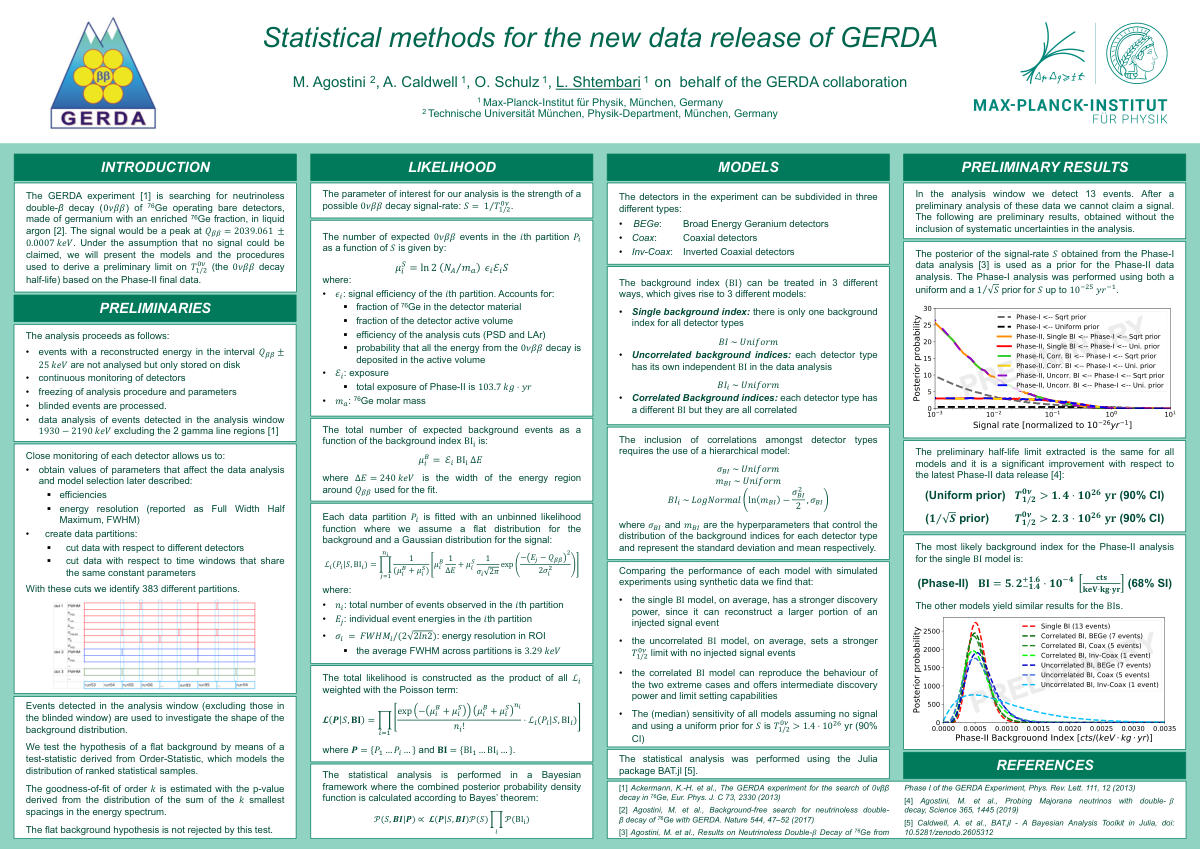
The GERDA experiment investigates lepton-number violation and whether neutrinos have a Majorana nature by searching for a rare nuclear transition called neutrinoless double beta decay (0vbb). The statistical challenges that arise in the search for rare-processes: evaluating the discovery power, the limit setting power on the signal rate and the goodness of fit of the background for models with data sets consisting of a small number of events are discussed. The topics selected include the systematic variations in the results due to the choice of fit models. This is investigated through Bayesian Hierarchical modelling. Order statistics and the Bayes factor are used as tools to study the background goodness of fit and the signal discovery power.
Conference Information
Identifiers
Authors
Matteo Agostini
Technical University of Munich
Allen Caldwell
Max Planck Institute for Physics
Lolian Shtembari
Max Planck Institute for Physics
Oliver Schulz
Max Planck Institute for Physics