Description
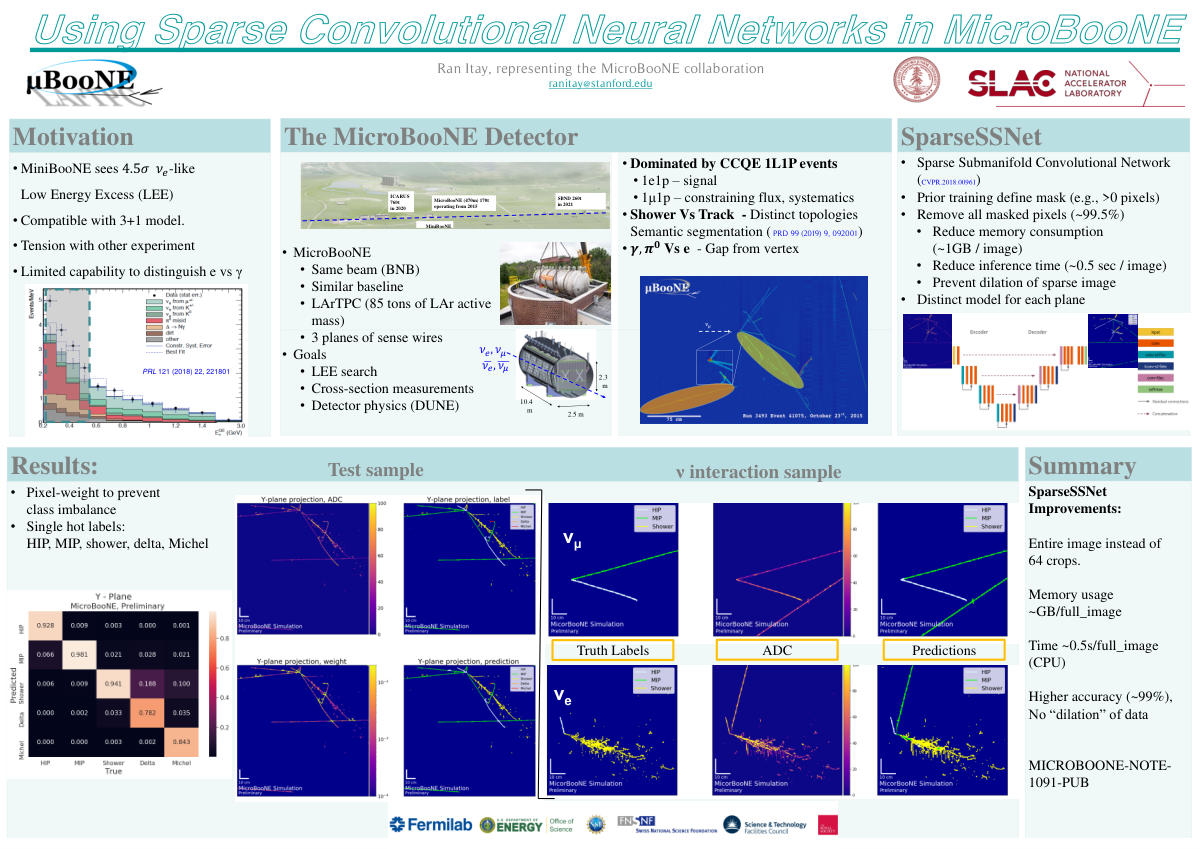
The MicroBooNE experiment employs a Liquid Argon Time Projection Chamber (LArTPC) detector to measure sub-GeV neutrino interactions from the muon neutrino beam produced by the Booster Neutrino Beamline at Fermilab. Neutrino oscillation measurements, such as those performed in MicroBooNE, rely on the capability to distinguish between different flavors of neutrino interactions. Deep Convolutional Neural Networks (CNNs) present high success for these tasks; however, due to the large sparsity of the data ( < 1% pixels are non-zero), a naive approach of applying CNNs becomes highly inefficient in both computation time and memory resources. Recently Submanifold Sparse Convolutional Networks (SSCNs) have been proposed to address this challenge and have successfully applied to analyze large LArTPC images in MicroBooNE with orders of magnitude improvement in computing resource usage. In this poster, I will present the performance of SSCNs on the task of Semantic Segmentation applied in the analysis of simulated MicroBooNE data.
Conference Information
Identifiers
Authors
Ran Itay
Stanford University