Description
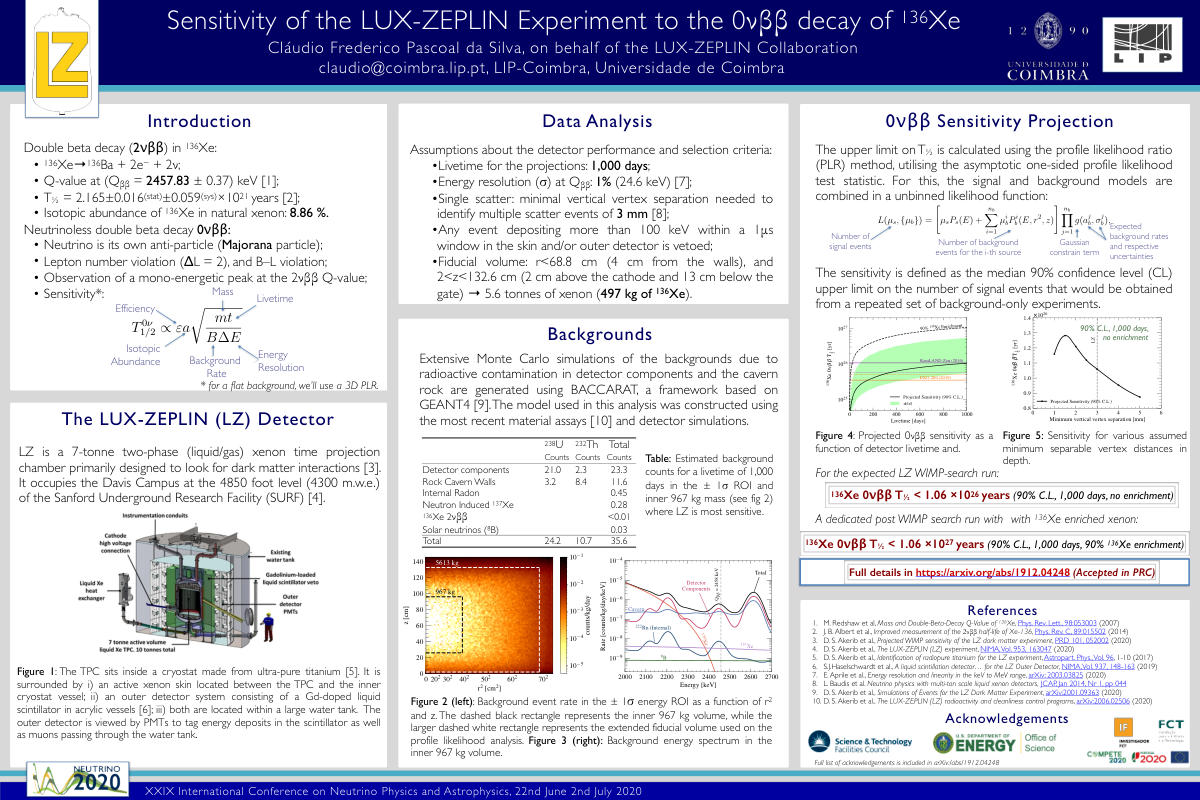
The LUX-ZEPLIN (LZ) experiment is a 7-tonne liquid xenon time projection chamber primarily designed to search for dark matter particles in the form of weakly interacting massive particles. Nonetheless, we can take advantage of the significant ${}^{136}$Xe mass (>600 kg) present in the active volume of the detector to look for neutrinoless double beta decay of that isotope. We report the projected LZ sensitivity to this decay after 1000 live-days without isotopic enrichment (half-life>$1.06\times 10^{26}$ years, 90% CL) and with a 90% isotopic enrichment with ${}^{136}$Xe (half-life>$1.06×10^{27}$ years, 90% CL). This result makes use of a profile likelihood ratio (PLR) method and includes updated background models, namely from the cavern walls, from the solar neutrinos, and neutron capture on ${}^{136}$Xe.
Conference Information
Identifiers
Authors
Claudio Frederico Pascoal Da Silva
University of Coimbra